Saturday, April 15, 2017

Hocus Pocus - Kurt Vonnegut


   1990; 323 pages.  New Author? : Heavens, no.  Genre : Contemporary Fiction; American Literature; Satire.  Overall Rating : 7*/10.

    “My name is Eugene Debs Hartke, and I was born in 1940.  I was named at the behest of my maternal grandfather, Benjamin Wills, who was a Socialist and an Atheist, and nothing but a groundskeeper at Butler University.”

    Thus starts Hocus Pocus, wherein Eugene recounts his life story, with most of the emphasis on the last couple of years, during which he has had some quite severe ups and downs.

    Through a connection with his former CO in Nam, Gene obtained a teaching position at Tarkington College, a private school in Scipio, New York for kids with learning disorders.  Alas, he eventually is fired that position, and takes a similar job at Athena State Prison, just across the lake from Tarkington.

    But a prison revolt leads to bloodshed, and Tarkington College becomes Tarkington Reformatory, upon which Gene is promoted to head warden.  In yet another twist of Fate, he’s now an inmate at the same prison he used to be the warden of.

    And so it goes.

What’s To Like...
    There are no spoilers in the above section; the reader is told all that within the first 4% of the book.  The main plot, and Kurt Vonnegut has never been known to pay undue attention to such a thing, is basically Gene telling you how he arrived at his present state of incarceration. 

    The book is written in the first-person POV (Gene’s), and is mostly stream-of-consciousness with lots of flashbacks.  For unknown reasons, Vonnegut spurned writing out any numbers.  So: “Vietnam was 1 big hallucination” instead of “one big hallucination”.  There are also “code phrases”, such as the titular “hocus pocus” standing for “bullsh*t”.  The Griot™ computer program was way kewl. And it was fun to watch the protagonist as he tries to compare the number of people he killed in Vietnam versus the number of women he’s been to bed with.

    The writing is of course superb, and there’s the anticipated abundance of Vonnegut wit, although for me, it didn’t seem to sparkle as much as usual. Perhaps this was because the themes in Hocus Pocus – the Vietnam war, the social castes in America, the rich vs. the poor class divisions, the broken-down jail system, etc. – are all familiar Vonnegut subjects.

    The book ends with Gene becoming an inmate in his own prison, which is a logical terminus, but I thought it was anti-climactic, since he doesn’t really share any of his experiences from behind bars.  But perhaps that’s covered in another one of his late-in-life books, Jailbird, which is sitting on my Kindle, waiting to be read.  There are some twists at the end, but they aren’t surprising since Vonnegut/Gene tells us of them several times along the story’s way.

    As with all of the author’s books, this is a standalone novel.  Although there are some recurring characters in Vonnegut novels,  he doesn’t do series.  I personally think this is a plus; you don’t miss a thing by not reading them in order.

Kewlest New Word. . .
Absquatulate (v.)  :  to leave abruptly; to flee; to abscond.  (Yankeeism)

Excerpts...
    At least the World will end, an event anticipated with great joy by many.  It will end very soon, but not in the year 2000, which has come and gone.  From that I conclude that God Almighty is not heavily into Numerology.  (loc. 66)

    “Did the letter say why you were named Rob Roy?” I inquired.
    “No,” he said.  “I assumed it must be because she liked the novel by that name by Sir Walter Scott.”
    “That sounds right,” I said.  What good would it do him or anybody else to know that he was named for 2 shots of Scotch, 1 shot of sweet vermouth, cracked ice, and a twist of lemon peel?  (loc. 3680)

Kindle Details...
    Hocus Pocus sells for $6.47 at Amazon.  The rest of Vonnegut’s novels are normally in the $4.99-$9.99 range, but if you keep your eyes peeled, you’ll find that Amazon frequently discounts them, one at a time, to $1.99, which is a fantastic price if you have the patience to wait Amazon out.  I’ve noticed that Amazon quite often discounts books by deceased writers.  I wonder if that’s because the authors are no longer around to protest the pricing policies of their works.

 “Plutonium!  Now there’s the stuff to put hair on a microbe’s chest.”  (loc  2513)
    Kurt Vonnegut was born on 11 November 1922 and died on 11 April 2007.  He wrote 14 novels over the course of his career, plus a dozen shorter pieces of fiction and 9 works of non-fiction.  Hocus Pocus was novel #13, and was published in 1990 when Vonnegut was 68 years old.

    It’s not that this is a bad novel; it’s just that there isn’t anything new for anyone who’s read other books by Vonnegut.  The main themes enumerated earlier will be already familiar to any inveterate Vonnegut fan; they’re just dressed up with different plot details this time out.  Certainly writing about the Vietnam War in 1990 can only be viewed as old hat.

    While reading Hocus Pocus, it occurred to me that Vonnegut might have written this to be kind of his swan song.  For instance, his Elders of Tralfamadore make a cameo appearance, and they have no literary reason to be here.  I even can’t help wondering if the title itself, which we’ve already noted as being code for “Bullsh*t”, isn’t a small, subtle joke by the author to his readers.

    7 Stars.  Hocus Pocus may not be Vonnegut’s best effort, but it doesn’t change my opinion that he is the greatest American author of the latter half of the 20th century.  Don’t agree with me?  Name a better choice.

Tuesday, April 11, 2017

Chronicles of M - Nicholas Forristal


    2013; 330 pages.  Book One  (out of 6) in the Chronicles of M series  New Author? : Yes.  Genre : Paranormal; Zombies; Dark Fantasy.  Overall Rating : 7*/10.

    For Sam Horn, this is a long-awaited day: it’s his first day of retirement, he’s here at the bank to make a deposit, and he’s feeling good.  For thirty-three years he’s been an agent for various spoiled movie celebrities, catering to their every whim and convincing studios they should put up with his clients’ insane demands.  But that’s all behind him now, and nothing’s going to ruin his day.

    Well, maybe not.  When a gang of bank robbers takes the whole place hostage, things could turn ugly.  But fortunately, Sam’s mastered the art of persuasion during his long career in Tinsel-town.  When his clients won’t be in the latest movie unless they get a gallon jug filled with red M&Ms, a bottle of whiskey made in Scotland between the years 1950 and 1960, and a dressing room with excellent Wifi reception, it’s up to her agent to sweet-talk the studio to feel good about acquiescing.

    It helps, of course, that our would-be robbers are rather dim-witted.  So it’s just another day at the job for Sam.  He just needs to convince them to set the hostages free, give themselves up, all in the belief that the courts will give them a lighter sentence for cooperating so freely.  No big deal.

    It works like a charm, Sam gets a small mention in the news reports, and he once again settles down to begin enjoying his retirement.  So imagine his surprise when he gets a message that someone saw his negotiating skills and wants to Sam to come to work for his company.  The details, however, are hush-hush until he commits.

    Now why would they do that?

What’s To Like...
    The Chronicles of M is the first installment in a 6-book series with the same name.  The series is complete, which is always nice to know.  There's action immediately, although thereafter it becomes somewhat sporadic.  This is a paranormal book, with the primary focus on zombies.

    I liked Nicholas Forristal’s approach to this.  Zombies are generally portrayed as slow-moving, brainless hero-fodder, and that gets old after a while.  Here you’ll learn about the 5-stages of zombie-ism, and maybe even develop a bit of empathy for them.

    I also liked the relationship between the two main protagonists – our hero Sam and our superhero “M”.  Instead of being buddy-buddies from the get-go, things are rather “frosty”.  M’s kind of a butthead, and Sam has few skills to complement his superhero pal.  The story is told in the first-person POV, mostly Sam’s, but a couple chapters are from M’s perspective.  There’s quite a bit of cussing, almost all by M, but hey, he’s just a hot-headed kid, isn’t he?

    There aren’t a lot of characters to keep track of – just focus on Sam, M, Thomas, and Marcus and you’ll be okay.  Don’t be fooled by a cameo appearance by someone named Ned; I’m pretty sure that was a pair of typos that should’ve been Todd.  The settings are similarly sparse – once you get beyond the NYC intro, you’re pretty much limited to the United Hero Defense ("UHD") headquarters and an out-in-the-sticks town called Dead Man’s Bluff.

    The ending is okay, but not spectacular.  Sam decides to sign up with the UHD (well, you knew that was gonna happen, elsewise there’d be no series, right?), and the causes of M’s mood issues are revealed, if not resolved.  There are lots more unanswered questions; presumably these are addressed as the series progresses.  Indeed, the ending felt more like a pause than a climax, albeit at a logical point.  But Nicholas Forristal’s writing skills were sufficient to  keep things from bogging down.

Excerpts...
    I sit up in my chair, “Okay, so M is a crime fighter, like a superhero?  And you are his sidekick?  Do you two wear costumes?  Can you fly?”  I let the sarcasm flow out of me.  M is maybe nineteen, at most.  Thomas actually thinks I’ll believe M is as old as I am?
    “Costume?  Have you ever tried to do anything in spandex, or even a suit?  I assure you, it’s no fun.”  (loc. 414)

    An explosion knocks me on my backside.  The door on the left side shoots across the hall and slams into the opposing wall with a thunderous boom.  Fire peeks out of the doorway as black clouds of smoke roll across the ceiling.  A man screams, “I told you not to do that!”
    Another voice responds, “Sorry, forgot the catalyst.”
    “Catalyst?  Are you kidding me?  If you had used the catalyst we’d be dead right now, you idiot!”
    “Don’t call me an idiot, jerk.”
    “Don’t call me a jerk, idiot.”  (loc. 1883)

Kindle Details...
    Chronicles of M sells for $0.99 at Amazon.  The other five books in the series go for $2.99 each.  You can buy the whole series bundled together for $15.94, but that saves you absolutely nothing.  And finally, you can buy books 1-3 bundled together for $6.99, but if you do that, you need to take a remedial math course.

To steal a line from Vonnegut, M is “unstuck in time.”  (loc. 2062)
    There are some quibbles.  While I wouldn’t call the pacing slow, it certainly isn’t brisk either.  We don’t meet our first zombie until 50%-Kindle.  Everything before that is world-building.  This is necessary, I suppose, for the 6-book series, but it’s going to be disappointing to anyone expecting the usual zombie-must-find-brains mayhem.

    The main snag for me was the lack of a main storyline.  The blurb makes it sound like it’s a tale about investigating some zombie killings, and it’s true that there's a plotline involving that.  But it’s almost a story tangent, and from start to finish, it lasts about 10%-Kindle.  Resolving it is neither difficult nor tense.

    All this isn’t helped by a number of side-stories that became a bit tedious.  I counted four of them – the tour of the HQ, the “mad baker”, Marcus’s backstory, and then M’s backstory as well.  Do they add to the world-building?  Yes, definitely.  Do they keep you on the edge of your seat?  No.

    In general, Chronicles of M reminded me of the first Men in Black movie, where Will Smith spends a lot of time trying to figure out what the heck is going on.  But there, a galaxy needed saving.  Here, you have to be content with just figuring things out.

    7 Stars.  I’m unsure how much significance to put on these quibbles.  It could be that Nicholas Forristal intends this first book to simply be an introduction to the rest of the series: get the characters onstage; get the world-building out of the way, and set the tone.  If the next five books are action-packed with compelling storylines, this is a small price (literally and figuratively) to pay.  But if the next five books have more backstories than thrills and spills, then things could drag.

Saturday, April 1, 2017

The Long Dark Tea-Time of the Soul - Douglas Adams


   1989; 250 pages.  Book Two (out of three) of the “Dirk Gently” series.  New Author? : No.  Genre : British Humor; Fantasy; Quasi-Mystery.  Overall Rating : 7½*/10.

    Dirk Gently, proprietor and sole employee of the Holistic Detective Agency, has a job!  It’s even a paying one, and he sure can use the money.

    Mr. Geoff Anstey is convinced that a 7-foot-tall, shaggy-haired, green-eyed monster is trying to kill him.  With a scythe, no less.  And he’s willing to pay Dirk a tidy sum to be his bodyguard.

    Dirk’s on his way to collect his first payment.  But the police cars parked all around the Anstey residence are not a good sign.  Neither is the crime scene tape roping off the area.  Dirk has a bad feeling as he ducks under the tape and enters the home.

    Things get even worse when he finds Geoff Anstey’s head.  On a record, on the turntable.  Without the rest of his body.  It appears Mr. Anstey will not be making his initial payment.

What’s To Like...
    The main theme of The Long Dark Tea-Time of the Soul, “when gods are past their prime”, has been done before.  It’s one of my favorite niche genres, and books dealing with it are reviewed here, here, and here.  AFAIK, it was first examined in an old (black and white) Star Trek TV episode, although I wouldn't be surprised to find out there are earlier sci-fi or fantasy examples.

    The first half of the book is pretty disjointed, but I get the feeling this was intentional.  Douglas Adams throws all sorts of threads and tangents at the reader, among them: Dirk’s refrigerator; an eagle with an attitude; a song about a hot potato; a coca cola vending machine; a table that turns into a kitten, mayhem at the airport (including a clueless would-be boarder, a missing check-in girl, and an explosion); and a boy hooked on video games in the same house as the decapitated client.  But the second half of the book is devoted to bringing all these things together and tying them up, which Adams succeeds in doing deftly, with the exception (unless I missed it) of the gamer kid.

    If you’re a Norse mythology buff, you’re in for a treat.  I also liked the electronic I Ching apparatus, the “non-fridge opening contest” between Dirk and his cleaning lady, and the tip of the hat to “The Ride of The Valkyries”, which always induces visions of Bugs Bunny and Elmer Fudd in my head.

     The book is written in “English”, as opposed to “American”, which means you occasionally have to decipher things like “hoovering” the carpet.  This is a standalone novel, as well as a part of a series, cut short by Douglas Adams’ all-too-soon passing away.

Kewlest New Word ...
Loured (v.) : frowned in a threatening way (often referring to clouds or the sky)
Others : Adumbrations (n., plural); Dordogne (n., proper, an area in France)

Kindle Details...
    Amazon offers the e-book version of The Long Dark Tea-Time of the Soul for $6.99.  But right now, you can get it and Book One of this series, Dirk Gently’s Holistic Detective Agency as a boxed set for only $4.99, thus saving a sizable chunk of cash.  The third and final book in the series, The Salmon of Doubt, sells for $7.99.  There also appear to be a number of fan-books available, starting at $1.99.

Excerpts...
    “You don’t look like a private detective.”
    “No private detective looks like a private detective.  That’s one of the first rules of private detection.”
    “But if no private detective looks like a private detective, how does a private detective know what he’s supposed not to look like?  Seems to me there’s a problem there.”
    “Yes, but it’s not one that keeps me awake at nights,” said Dirk in exasperation.  (loc. 1221)

    The Aries Rising Record Group, which had been founded on Sixties ideals, or at least on what passed for ideals in the Sixties, grown in the Seventies and then embraced the materialism of the Eighties without missing a beat, was now a massive entertainment conglomerate on both sides of the Atlantic.  Dennis Hutch had stepped up into the top seat when its founder had died of a lethal overdose of brick wall, taken while under the influence of a Ferrari and a bottle of tequila.  (loc. 2479)

 What god would be hanging around Terminal Two of Heathrow Airport trying to catch the 15:37 flight to Oslo?  (loc. 798)
    The ending of The Long Dark Tea-Time of the Soul felt a bit forced and anti-climactic to me.  I almost got the impression Adams was so happy about successfully tying all the subplot threads together that he forgot to do the same with the main plotlines – why Geoff Anstey lost his head, and why the gods were so weak.

    The baddies were lethal but not particularly scary.  And reading the book did require patience and trusting that things would eventually come together.  They do, but our two protagonists (Dirk and Kate) don’t meet until 50%, and Kate and Thor don’t cross paths until 58%.

    But if you can hang in there with the story until then, the rest of the book is an utter delight.  And of course, you’re treated to the trademark Douglas Adams wit throughout the book.

    7½ Stars.  Not quite as good as Dirk Gently’s Holistic Detective Agency (reviewed here), but still a worthwhile read. 

Sunday, March 26, 2017

Just Needs Killin' - Jinx Schwartz


   2014; 338 pages.  Book 6 (out of 8) of the “Hetta Coffey” series.  New Author? : Yes.  Genre : Crime Mystery; Humor.  Overall Rating : 7½*/10.

    Hetta Coffey is going to a party.  And a posh affair it’s going to be, too.  Which is quite unusual, given the locale is the Baja California peninsula of Mexico.  Hetta’s going as the guest of her best bud, Jan, who’s been hired for the night by the host of the party, a chap named Hiro Ishikawa.

    Ishikawa’s paying Jan to be his “escort” during the party.  Hmm.  That sounds like there’s some strings attached.  Bedroom strings.  But Jan assures Hetta that no such extracurricular activity is included.  Instead, Ishikawa will be paying her $50,000 just to be his companion as he mingles with the partygoers, with the money going towards funding Jan’s boyfriend’s search for a sunken galleon.

    Man, that seems an exorbitant price to pay for one night’s worth of “everything’s above the board” escorting, doesn’t it?  Is Ishikawa out of his mind?!

    Well yes, as a matter of fact, he is.  Actually, he’s completely out of his head.  Someone has just decapitated him.

What’s To Like...
    I liked the setting for Just Needs Killin’: everything takes place in various towns and marinas up and down the two sides of Baja California..  A lot of it is aboard Hetta’s modestly-sized yacht.  The author’s Amazon blurb indicates she lives on a boat in the same area, and the literary maxim of “write about what you’re familiar with” is put to good use here.

    There are some Japanese phrases thrown in, which I thought was kewl since I know virtually no Japanese.  And some Spanish as well, which I have some familiarity with.  I learned what a “panga”  and a “hotel de paso” are, and appreciated the brief tip-of-the hat to the Kingston Trio, one of my favorite folk groups.  Also, I thoroughly liked the fact that Hetta's an engineer by vocation, even more so that she’s probably a chemical engineer who until recently was working with a copper mine in Mexico.  My company in real life sells chemicals to copper mines in Mexico, so this was a pleasant, unlooked-for tie-in.

    The story is written in the first-person POV, and Hetta reminded me a lot of Janet Evanovich’s Stephanie Plum.   This POV means, however, that a lot of the action – the killings and abductions, for instance – takes place off-stage, so the book verges on being a cozy.  To boot, there is a lot of over-the-top stuff: things like a secret corridor on a boat (huh?), a bad guy brandishing a rather non-lethal weapon and hoping no one notices (oh, come on, now), and the whole idea of two little amateur ladies deciding to take out a Mexican gangster on his home turf (don’t try this in real life).   However, it’s no more far-fetched than the stuff Clive Cussler writes, so if Dirk Pitt’s your idea of a hero, you’ll probably enjoy meeting Hetta Coffey.

     Just Needs Killin’ is a standalone novel while also part of a series.  This was my first Hetta Coffey novel, but I didn’t feel like I missed much by not having read the first five books.  The pacing is fast, the dialogues are amusing, and there were no slow spots.  It’s all about the action.

Kewlest New Word…
Panga (n.) : a modest-sized, open, outboard-powered fishing boat common throughout much of the developing world.

Excerpts...
    “Now, there you go, I am no longer a witness, but a full fledged co-conspirator.”
    I gave her a high-five.  “Thelma and Louise!”
    “Butch Cassidy and the Sundance Kid!”
    “Bonnie and Clyde!”
    Jan lost her grin.  “Uh, Hetta.  Didn’t all of them, like, die?”
    “We all die.”  (loc. 1869)

   “You two lost another anchor?” Chino said at dinner that evening.
    “Lost is such a harsh word.”
    Chino grinned at me.  “What word would you use to describe cutting two anchor lines in less than two months?”
    “Uh, temporarily misplaced?”  One thing for sure, both anchors were incriminating evidence that we were somewhere we were not supposed to be.  “You can dock my pay.”
    “You aren’t getting paid.”
    “See, problem solved.”  (loc. 3579)

Kindle Details...
    Just Needs Killin’ sells for $3.99 at Amazon, which is the standard price for all of Jinx Schwartz’s e-books, including the other seven books in the series, and two other books outside of it.  The 8-book Hetta Coffey series is also available as two 4-book bundles for $9.99 each, which is a nice bit of savings if you intend to read the whole set.

 “When seconds count, the cops are only minutes away.”  (loc. 1184)
    There are a couple quibbles.  I struggled to determine the overall plotline.  It seemed like it couldn’t make up its mind what it wanted to be.  The story starts out as a murder-mystery, but that fades away,  its place is taken by a plot concocted by the heroes to kill the big bad baddie.  Soon afterward, it moves on to “find the treasure”, then pops back to kill the baddie again, and finally switches to a  “find a different treasure” theme.  Mixed into this was a “what to do about dear Aunt Lillian” tangent which never did seem to have any impact on any of the other plotlines.

    All this hopping around of the storylines made for a rather disjointed read.  But I’m new to the series, so maybe this is the norm for a Hetta Coffey tale.

    Then there was the repeated use of ethnic-based wit.  Mexicans and Japanese get stereotyped to death, and even Canadians get poked fun at on one occasion (40% Kindle).  I recognize that some ethnic bantering is inevitable in a setting like this one, but does it have to be the major source of wit?  I’d think Hetta would have a greater appreciation of Mexican culture, being immersed in it as she is.

    7½ Stars.  Setting the quibbles aside, I found Just Needs Killin’ to be a fast-moving, fun, light read, one that’s ideal for an afternoon at the beach or for a stretch on an airplane.  For me personally, it was the perfect reading balance as I continue to slog my way through Thomas Pynchon’s Gravity‘s Rainbow opus.

Friday, March 17, 2017

Eats, Shoots and Leaves - Lynne Truss


   2004; 209 pages.  Full Title : Eats, Shoots & Leaves: The Zero Tolerance Approach To Punctuation.  New Author? : Yes.    Genre : Non-Fiction; Punctuation; Reference; Humor.  Laurels : Winner: “Book of the Year” – British Book Award 2004; New York Times #1 Bestseller for three straight weeks (May 30 thru June 13) in 2004.  Overall Rating : 9½*/10.

    Are you a punctuation stickler?  Does it grate your nerves when people mess up using its/it’s?  If you saw the sign: “Come inside for CD’S, VIDEO’S, DVD’S and BOOK’S!” would you have the desire to run screaming into the store, telling the proprietor to correct that atrocity immediately?!

    Do you yearn to know the eight different uses of the apostrophe, the six uses of the comma (plus a couple of situations where they’re optional), and the ten (count ‘em, ten!) various uses of the hyphen?

    Do you worry that the semicolon is heading toward extinction?  Do you have an opinion about the Oxford comma?  What about double possessives (“a friend of the couple’s”)?  Are you aware that brackets come in no less than four different forms?

    If your answers to one or all of these questions is “Yes!  Damn right!”, then Eats, Shoots & Leaves is a must-read for you.  Prepare to be excited! Motivated!  And join with others of us in shouting the slogan coined by the author of the book :

    Sticklers unite!  You have nothing to lose but your sense of proportion (and arguably you didn’t have a lot of that to begin with).

What’s To Like...
    Eats, Shoots & Leaves’ sole subject is punctuation.  Normally, this is an yawn-inducing topic, but Lynne Truss keeps you entertained with fascinating anecdotal history, eyebrow-raising trivia, and dry, British wit that will have you chortling.

    But don’t be lulled into a false sense of hilarity; this book will also answer any questions you may have about proper punctuation.  I was particularly keen on this because commas have always been daunting to me.  When do you use them?  Where do you place them?  Are there “gray areas” where their use is a matter of opinion.  This book answered all my questions.

    The anecdotes are great.  You’ll learn about the Jameson Raid telegram and its disastrous consequences due to ambiguous punctuation.  You’ll discover that the Bible in its original form has no punctuation marks, leaving some critical passages open to Catholic-vs-Protestant interpretation.  And I’m eager to get my membership in the Apostrophe Protection Society, which really exists.

    I liked the book’s structure.  A whole chapter on the apostrophe, followed by a whole chapter on commas.  Then one detailing the finer points of colons and semicolons; followed by one on a bunch of the “lesser” bits of punctuation: exclamation points, question marks, italics, quotation marks, the dash, brackets, “sic”, and the esoteric ellipsis (three dots).  After a short chapter about hyphens, the book closes with the author’s  “where do we go from here?” speculation.  Yes, emoticons get some ink, but it was the interrobang that really caught my eye.

    It should be mentioned that, like grammar, the rules for proper punctuation change with time.  And that the British rules for punctuation are sometimes different than the American rules.  Lynne Truss points out these variances along the way, but Eats, Shoots & Leaves is written, and punctuated, in English, not American.

Kewlest New Word. . .
Solecism (n.) : a grammatical mistake in speech or writing.
Others :  Loudhailer (n.); Naff-all (adj.).

Excerpts...
    The stops point out, with truth, the time of pause
    A sentence doth require at ev’ry clause.
    At ev’ry comma, stop while one you count;
    At semicolon, two is the amount;
    A colon doth require the time of three;
    The period four, as learned men agree.  (loc. 1100)

    (T)here will always be a problem about getting rid of the hyphen: if it’s not extra-marital sex (with a hyphen), it is perhaps extra marital sex, which is quite a different bunch of coconuts.  Phrases abound that cry out for hyphens.  Those much-invoked examples of the little used car, the superfluous hair remover, the pickled herring merchant, the slow moving traffic and the two hundred odd members of the Conservative Party would all be lost without it.  (loc. 1568)

Kindle Details...
    Eats, Shoots & Leaves sells for $11.99, although I snagged it when it was discounted for a short time.  Lynne Truss has three other reference books; they are in the $10.99-$14.99 range.  She also has written several humor-fiction novels, and they are more modestly priced in the $0.99-$3.99 range.

 “Getting your itses mixed up is the greatest solecism in the world of punctuation.”  (loc. 521)
    The quibbles are minor.  My main gripe is that the book is very short.  There are only  209 pages, and the first 24% of the book is consumed by a Forward, a Publisher’s Note, and Preface, and an Introduction.  Also, the “reference” links didn’t work and worse yet, didn’t give you an option to get back to your original page.

    But that’s about it for the quibbles.  The bottom line is, I was looking for a book that would amuse me to no end, teach me the right and wrong usages of punctuation, and most importantly, tell me where I have options.  Eats, Shoots & Leaves did all of this, and more.

    9½ Stars.  I remember Borders Bookstores promoting the heck out of Eats, Shoots & Leaves when it first came out.   For quite a few months, that cute, homicidal panda on the book cover would beckon to you as you stood in line waiting for the next available cashier.  I regret now that I didn’t give in to that bit of enticement.  <Sighs>  RIP, Borders: b. 1971, d. 2011.

Friday, March 10, 2017

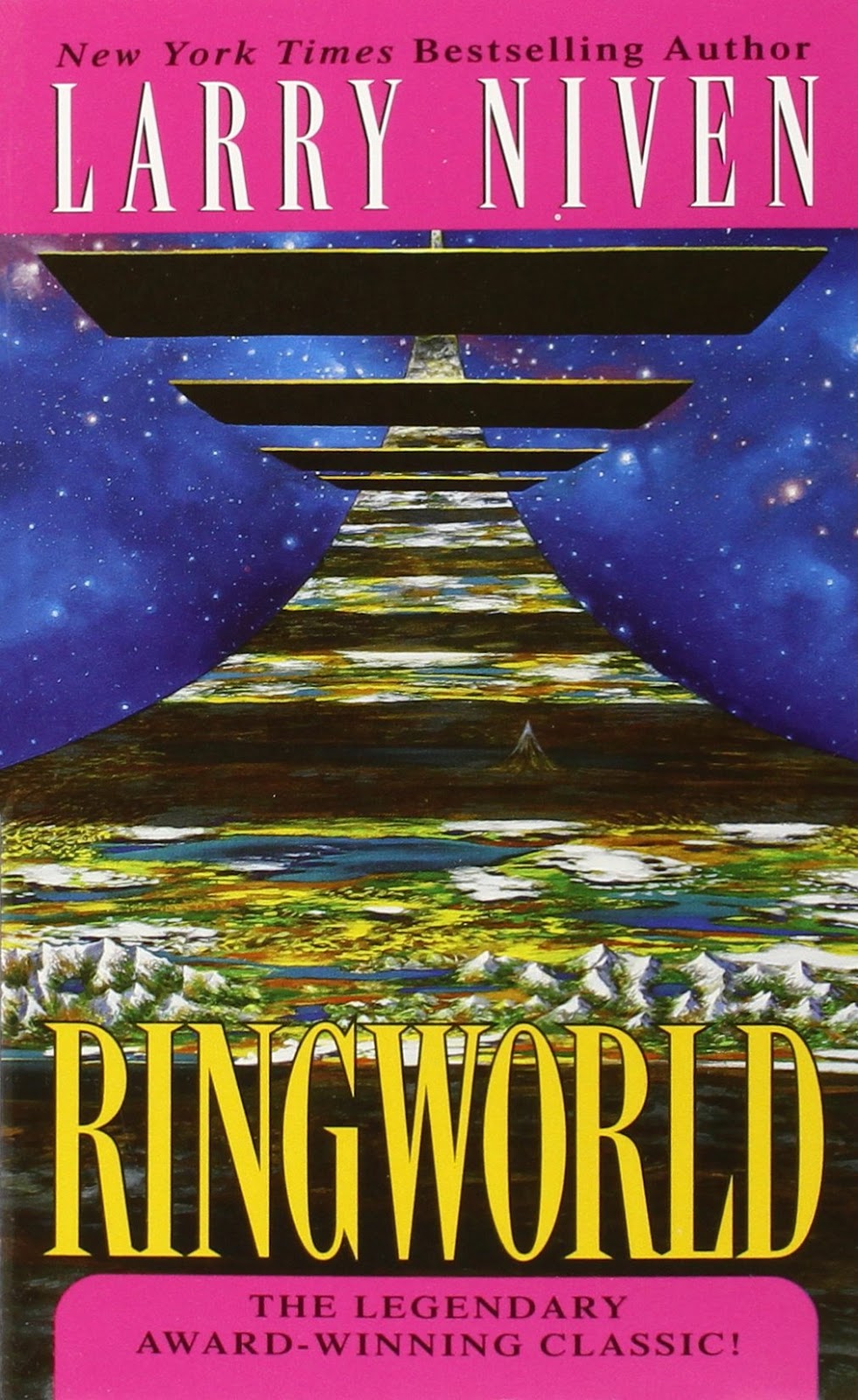
Ringworld - Larry Niven


    1970; 342 pages.  New Author? : Yes.  Book One of the Ringworld series, which subsequently grew to 4 sequels and 4 prequels.  Awards : Nebula Award (1970); Hugo Award (1971); Locus Award (1971).  Genre : Hard Science Fiction; Space Opera; Classic Sci-Fi.  Overall Rating : 8½*/10.

    Louis Wu is the Chosen One.  An artificial Dyson sphere (ring, actually) circling a faraway sun has been detected, and someone needs to go check it out.  If habitable, it could solve a coming cosmos-wide crisis.

    Well, truth be told, he’s actually only one of four Chosen Ones, and one of the others is doing the choosing.  Still, for a jaded, Boosterspice-using, 200-year-old human, it is a chance to once more venture into unknown portions of the universe, see new things and, if he’s lucky, meet new beings.  Maybe even new species.

    Of course, the recruiter is a Pierson’s puppeteer, and they are known to be master manipulators, always with ulterior motives.  And since there will only be four of them making the journey, if the Dyson sphere is inhabited by hostiles, this will probably be a suicide mission.

    But Pierson’s puppeteers are known to manufacture spaceships with hulls that are almost impregnable, and if by chance Louis does perish in the adventure, well, it’s been a good life.

What’s To Like...
    Ringworld is a groundbreaking “hard” science fiction epic that was published in 1970 and garnered a number of sci-fi awards and generated oodles of scientific debate that year and the next.  The story is awash with futuristic devices – slidewalks, transfer booths, a Kemplerer (sic) rosette, a hyperspace shunt (which gets around that pesky “can’t travel faster than the speed of light" issue), and the aforementioned Dyson sphere.  I’m a science geek and a sci-fi geek, so I ate it up.

   The world-building and species-building are fantastic.  I learned a neat new expletive, “Tanj”, which is an acronym for “There ain’t no justice!”  And the use of a tasp instead of a taser is a marked and curious development.  There is also plenty of wit and humor, including selecting Lying Bastard as the name of the expedition’s ship, and a coitus interruptus incident involving a rabbit.

   If you’re tired wading through dozens of characters in a novel, then Ringworld’s your book.  The four members of the team are the only ones you need to keep track of, and each of them is a fascinating study.  The Pierson’s puppeteer is called Nessus, and I always like it when humans aren’t at the top of the evolutionary pyramid.  In fact, here, they might not even be #2.  Speaker-to-Animals is a kzin, and he supplies the muscle for the group.  Teela is a young human who, Nessus claims, brings genetically-enhanced luck to the party.  And Louis, well, he’s not sure why he was selected, but he’s happy to be along.

    There “cussing” is kewl.  Instead of the standard expletives, which can be off-putting to some, we  are treated to phrases like “Tanj”, “Tanjit”, “Finagle knows”, and the somewhat insulting-but-in-a-friendly-way appellation “Leucote”.

    The ending is a double feature.  There’s a prosaic one, wherein our explorers figure out a way to get off Ringworld.  And there’s surprising one that I didn’t see coming at all.  Along the way, Larry Niven gives us some fascinating insight about interspecies cooperation, religion as a natural consequence of a collapsed civilization, and the proper precautions to take when initiating a “first contact” situation.

Kewlest New Word...
Particolored (adj.) : having a predominant color broken by patches of one or more other colors.

Excerpts...
    “You’re going to chase them down?”
    Speaker did not recognize sarcasm.  “I am.”
    “With what?”  Louis exploded.  “You know what they left us?  A hyperdrive and a lifesystem, that’s what they left us!  We haven’t got so much as a pair of attitude jets.  You’ve got delusions of grandeur if you think we can fight a war in this!”
    “So the enemy believes!  Little do they know –“
    “What enemy?”
    “-that in challenging a kzin-“
    “Automatics, you dolt! An enemy would have started shooting the moment we came in range!”
    "I too have wondered at their unusual strategy.”  (pg. 123)

    In the asteroid belt of Sol, men spend half their lives guiding singleships among the rocks.  They take their positions from the stars.  For hours at a time a Belt miner will watch the stars: the bright quick arcs which are fusion-driven singleships, the slow, drifting lights which are nearby asteroids, and the fixed points which are stars and galaxies.
    A man can lose his soul among the white stars.  Much later, he may realize that his body has acted for him, guiding his ship while his mind traveled in realms he cannot remember.  They call it the far look.  It is dangerous.  A man’s soul does not always return.  (pg. 161)

“Remember the Finagle Laws.  The perversity of the universe tends toward a maximum.”  (pg. 142)
    Ringworld is not a perfect book.  Between the “sciency” technical details and the interactions amongst the four protagonists, the plot sometimes stalls.  In a book 342 pages in length, we don’t land on Ringworld until page 133, don’t see the first sentient Ringworlders until page 159, and don’t make “first contact” until page 170, which is the halfway point.

    Indeed, for a while I wondered just where the storyline was going.  The various stops on Ringworld were interesting, but I kept waiting for something epic to occur.

   But it should be remembered that Ringworld was written in 1970, and science fiction in those days was a somewhat tame affair.  For its time, Ringworld was outstanding and probably derivative of both hard science fiction and space opera.

    8½ Stars.  There's a reason why it won all those awards listed in the header of this review.

Monday, March 6, 2017

The Dragon's Breath - Jamie Sedgwick


   2013; 327 pages.  Book 3 (out of 4) in the Aboard The Great Iron Horse series.  New Author? : No.  Genre : Steampunk Fantasy.  Overall Rating : 6*/10.

    It’s desperation time for Socrates and the crew of their locomotive, The Great Iron Horse.  They are out of their vital fuel, Starfall, and thus reduced to scrounging for their fallback energy sources, wood and coal.  These are not readily available, due both to the surrounding landscape and the fact that their train is a half mile long.

    So their hopes are lifted when late one afternoon they pull into a quaint town called Stormwatch, with an overlooking castle, Dragonwall, and find an indication that there may be some Starfall nearby.  The townsfolk don’t seem hostile, which is a welcome relief.  They do have a rather odd parting phrase though.  “Beware the dragon’s breath!”

    Ah, but I don’t see any dragons around; do you?  And if one does appear, and has a bad case of halitosis, well so what?  We have a good fighting crew, and we can always pop a breath mint in the reptile’s mouth.

    But hey, the sun’s about to set, the locals are scurrying to their houses, and time’s a-wasting.  So let’s get scouting for Starfall without further ado.

What’s To Like...
    The Dragon’s Breath is the third book in a series set in a wonderful post-apocalyptic steampunk world.  Socrates is a mechanical ape, and the head of a band of train-riding explorers tasked by their far-distant home base of Sanctuary with finding the indispensable, life-saving Starfall.

    This book is similar in style to the first two in the series.  The action starts immediately, and doesn’t let up.  There’s lots of bloodshed and violence, and there are simply are no slow spots.  The writing is not spectacular, but it’s sufficient for making you keep turning the pages.  If you like your stories with lots of mechanical details (if you fancy Tom Clancy), this book’s for you.  And if sand worms are your favorite beastie (if you’re a Dune loon), you’ll not not be disappointed.  Finally, if your tail’s a-waggin’ for dragons, you’re in for a treat.

    The backstory of this world is given at 54%, and I always appreciate that.  As with the previous book (reviewed here), the plotline, while exciting, is not very twisty.  Jamie Sedgwick mixes in enough wit and humor to keep you entertained; I found Kale’s attempt to ride a mechanical horse (18%) to be hilarious.  A holdover thread from the previous book (Burk) is resolved here.  

    Everything builds to a properly tense ending.  This borders on being a standalone novel, despite being part of a series.  The target audience seems to be adventure-reading YA boys, except that there’s an attempted rape (again) at one point.  So I’m not sure.  There are also a number of annoying typos.  I don’t normally mention these unless they are excessive, but at one point here, Sir Elbereth temporarily becomes Sir Elberone.  That’s kinda unforgivable.  The proofreaders should be shot.

Excerpts...
    “What are you working on?”
    “It’s a portable submersible oxygenation apparatus.”
    “A what?”
    “After our trip through the Forgotten Sea, I thought it might be useful to create some sort of portable breathing system, in case we’re ever trapped underwater again.”
    “So it’s an air mask?” Micah said.
    River looked at him.  “No, it’s a portable submersible oxygenation apparatus.”  (loc. 58)

    At last, Dane sat up and said, “Well, I suppose it doesn’t matter.  I can’t spend my nights worrying about rocks falling from the sky when I have very real dragons in my own backyard.  Believe me, there’s nothing worse than waking up face to face with a dragon.”
    “I know the feeling,” said Kale.
   Dane looked at him.  “Is that so?”  (loc. 1916)

Kindle Details...
    The Dragon’s Breath sells for $2.99 at Amazon.  As is usual for most of Jamie Sedgwick’s series (and he has a bunch of them), the first book, The Clockwork God, is free, and the second book, Killing The Machine, is $0.99.  I find this to be a most effective marketing device.  There is now a fourth book in this series, Clockwork Legion, and it sells for $3.99.

“She’ll be fine as soon as she remembers she’s not a rooster.”  (loc. 1019)
    There are weaknesses.  The dragons may be mean and nasty, but they’re not very resourceful.  This allows the strategy for Socrates and his cohorts to basically be: “I came, I plotted, I conquered”.  It’s a bit boring when the baddies can’t come up with anything surprising.  Similarly, the titular “dragon’s breath” is easily avoided.  And after Burk gets sprung, it was immediately obvious, who done it.  So why did it take Socrates so long to figure things out?

    More serious were the storytelling WTF’s.  The townspeople give our heroes the sage admonition “Beware the dragon’s breath!” but then fail to provide any details about what exactly  that danger is.  WTF?  And when River tries to deal with an undetonated artillery shell, she ties a noose around it and drags it along behind her speeding vehicle.  Holy explosive situation, Batman!  WTF?

    Last but not least, is the epilogue.  A goodly supply of the vital Starfall is recovered.  Yet somehow, after three books of harrowing adventures traveling aboard the Great Iron Horse, including a trip underneath an ocean, the precious cargo is dispatched back to Sanctuary, with nary a detail about just how this was accomplished.  WTF?  I wonder if they shipped it by USPS (United SteamPunk Service)?  That tale could’ve been a great addition to this series.

    6 Stars.  Overall, this felt like a “let’s crank another one out” effort.  All the requisites for a steampunk thriller are here, but without much of a creative spark.  This is probably as far as I’ll go with this series.

Thursday, March 2, 2017

Small Gods - Terry Pratchett


   1992; 344 pages.  Book 13 (out of 41)  in Terry Pratchett’s Discworld series.  New Author? : No.  Genre : Fantasy; Humor; Satire.  Overall Rating : 10*/10.

    It must be Brutha’s lucky day.  Om, the patron god of his hometown Omnia has designated him, a mere novice, to be his “Chosen One”.

    Unfortunately, Om has fallen on hard times lately, and for the last three years he’s been stuck in a most humiliating manifestation – a turtle.  Still, he is a god, and one of the miraculous things he can do as a turtle is speak to his Chosen One.

    For Brutha, this is a mixed blessing.  On one hand, it’s kind of nice to be able to chat with a deity, even if the god-given advice  is rather worthless.  On the other hand, being the only one who can hear Om, Brutha looks like a crazy man when he’s speaking to the turtle.  And others notice this kind of eccentricity

   Such as Deacon Vorbis, who speaks for Om, even though he’s never ever spoken with Om.  And Deacon Vorbis also happens to be the head of the Inquisitors, which means he has ways of seeing what’s inside your head.

    Such as drills, and tongs, and fire, and other extremely uncomfortable implements.

What’s To Like...
    Small Gods is kind of a one-off tale in the Discworld Universe.  The only “regulars” we meet are DEATH,  the librarian (who only makes a cameo appearance), and Cut-Me-Own-Hand-Off Dhblah, a take-off of the ubiquitous Cut-Me-Own-Throat Dibbler.  But not to worry, the new characters are fun to meet, including a host of philosophers, religious figures, and gods.  My favorite was St. Ungulant, an anchorite who dwells way out in the desert, although the eagle is pretty kewl too.

    The “small gods” concept is explained early (page 6), and is basically this: a god has power(s) proportional to the number of his followers, and what those believers are.  So being god over a bunch of humans is much better than being one over a bunch of bacteria.  And when your following dwindles to, say, zero, you cease to exist.  Om is down to his last believer, and so is relegated to being a turtle.

    Small Gods is Terry Pratchett at his finest.  There are footnotes, but no chapters.  The wit and silliness abound.  And yet he tackles a sensitive subject in the form of organized religion, and handles it evenly and subtly enough to where I don’t think anyone would take offense.  Structurally, the storyline is perfect, with everything building to a great, twisty ending.  There’s even an unusual (for Discworld tales) epilogue, wherein we learn the rest of Brutha’s story.

    Balanced against the serious themes of torture and war in the name of a god, Pratchett gives us some interesting views on things like the art of Philosophy, the worth of libraries, and the assets and liabilities of learning to think for yourself.  We even get the “creation story” behind Discworld (page 25), which was quite the treat.

    As usual, there are lots of smaller details to enjoy.  My favorite religion, Gnosticism, gets a brief mention.  So does eidetic memory and the shadowy History Monks.  Small Gods is an easy and fun read, which is no small feat when addressing topics such as the Inquisition.

Kewlest New Word. . .
Soughing (v.) : making a moaning, whistling or rushing sound (such as the wind in the trees)
Others : Baulks (n., plural); Anchorite (n.); Sophistry (n.)

Excerpts...
    “If you’re really Om, stop being a tortoise.”
    “I told you.  I can’t.  You think I haven’t tried?  Three years!  Most of that time I thought I was a tortoise.”
    “Then perhaps you were.  Maybe you’re just a tortoise who thinks he’s a god.”
    “Nah.  Don’t try philosophy again.  Start thinking like that and you end up thinking maybe you’re just a butterfly dreaming it’s a whelk or something.”  (pg. 101)

    “I’m reminded of the time when old Prince Lasgere of Tsort asked me how he could become learned, especially since he hadn’t got any time for this reading business.  I said to him, ‘There is no royal road to learning, sire’ and he said to me, ‘Bloody well build one or I shall have your legs chopped off.  Use as many slaves as you like. ‘  A refreshingly direct approach, I always thought.  Not a man to mince words.  People, yes.  But not words.”
    “Why didn’t he chop your legs off?” said Urn.
    “I built him his road.  More or less.”
    “How?  I thought that was just a metaphor.”
    “You’re learning, Urn.”  (pg. 208)


 The trouble with being a god is that you’ve got no one to pray to.  (pg. 11)
    Small Gods has been on my TBR shelf for a number of years now.  I’m not sure why it’s taken me so long to get around to reading it – I knew going in it was often considered Terry Pratchett’s best effort from his most creative era.

    I don’t have anything negative to say about the book, and I was impressed by how evenly the author, an avowed humanist, handled the whole touchy subject of religion.  So go out and find the book, and treat yourself to a fascinating tale, and remember the mantra: “The Turtle Moves”.

    10 Stars.  When you can’t find anything at all to quibble about, what other rating can you give?