Thursday, August 29, 2013

Shaman, Healer, Heretic - M. Terry Green


    2011; 338 pages.  Book One in the “Olivia Lawson Techno-Shaman” series.  New Author? : Yes.  Genre : Urban Fantasy.  Overall Rating : 8*/10.

    Things are amok in the Multiverse.  Particularly in the Underworld, where Shamans normally ply their trade.  They are now being attacked there and in some cases killed.  In our dimension, this is of small interest, since ordinary people don’t consciously venture into the Multiverse, and shamans (shamen?) are not held in high regard.

    But for Livvy, a young and practicing techno-shaman, the perils in the Underworld impact her livelihood, as people pay her to travel there and bring souls back to the here-&-now.  But after one encounter with the creature wreaking the havoc “over there”, Livvy’s convinced that she’s no match for it.  For that matter, no shaman is.  What can be done?

What’s To Like...
    The core concept of “techno-shamanism” is original and fascinating.  Why not utilize 21st-century technology to navigate through the spirit realms?  The story is fast-paced, with no slow spots.  The chapters are short – think James Patterson length - which makes for an easy read.  The setting/premise will remind you of Jim Butcher’s Dresden Files series, so if you like that series, you'll like this one too.

    There is one assault, plus some brief mentions of vodka and cigarettes; but Shaman, Healer, Heretic is still geared toward the YA market.  The book has some great points about teamwork, multiculturalism, religious prejudice, and girl-power (all the shamans here are female).  There is some budding romance, but nothing steamy or R-rated.

    The overall concept of shamanism is captured reasonably well, and when’s the last time Sumerian gods showed up in the book you were reading?  The breadth of techno-shamanism is rather narrow here; Livvy’s “jobs” seem to be mostly limited to pulling clients out of comas.  But I’m guessing the job description will get more complex as the series progresses.

    I also imagine the Multiverse – consisting of an Underworld, Middleworld, and Upperworld - will get fleshed out in the sequels.  For now, they are sufficiently detailed to allow for the story to proceed at a satisfyingly rapid clip.  But I was left wanting to "see" more of their terrain.

    A couple of the plot twists that M. Terry Green weaves into the story seem forced and abrupt.  But the ending ties the basic plotline up nicely, while leaving a bunch of secondary loose ends for fiction fodder in the subsequent books.

Kewlest New Word...
Cabochon (n.) : a gem shaped and polished, but not faceted, often in an ellipse shape.

Excerpts...
    “Why didn’t somebody call me?” she asked, angry.
    The nurse went over to the monitors and started punching buttons, making the machine squeal occasionally.  Mitch grimaced at the noise.
    “Our shaman managed to do more than all of you people in this building put together,” said Diana.
    Oops, Livvy thought.  Time to go.
    “Shaman?” the nurse yelled, glaring at Livvy, who was stowing the water and other gear.  “If she touched him or gave him anything, we’re not responsible.”  (loc. 1144)

    “Tell me you are not serious,” he said.
    “It’s not really dying,” said Livvy.  “It’s just that your heart has to stop.”
    “Will you listen to yourself?  ‘Your heart has to stop.’  That’s insane!”
    “Insane?” asked the Nahual, turning around.  “Well, perhaps a little.”  (loc. 5316)

Kindle Details...
    Shaman, Healer, Heretic sells for $3.99 at Amazon.  The second and third books in the series are also available, both selling for the same price.

“Even for a techno-shaman, a kachina in the bedroom wasn’t exactly part of the drill.”  (loc. 43)
    I am certainly not the target audience of SHH, but I found it to be an delightful read.  Some questions did pop up in my mind though.

    Why did one of the gods have to be “summoned” before he could make an appearance?   Are there any male shamans?  By definition, can you really kill a deity?  Is the Middleworld necessary?  Do techno-shamans do anything besides coma-curing and dimension-hopping?

    I doubt YA readers will be bothered by such trivialities.  They’ll just sit back and enjoy the story.  Which is really the proper thing to do.

    8 Stars.  Oh yeah, a couple quibbles.  A “female god” is a.k.a. a goddess.  And Lapland does not extend all the way to Siberia. Just sayin’.

Thursday, August 22, 2013

Foucault's Pendulum - Umberto Eco


   1988; 533 pages.  New Author? : Yes.  Genre : Contemporary Fiction; Highbrow Literature.  Overall Rating : 8*/10.

    Where’s the Holy Grail?  What are the Rosicrucians hiding?  Who can tell me what the big secret is that the 32nd level of the Masons are hiding?  Surely all of this is interconnected.  But how?

   Everybody and his brother are writing their theories about this, and submitting their manuscripts to Garamond Publishing.  It falls upon Casaubon and his two colleagues to read through all these submissions.

    To relieve their boredom, they decide for develop their own secret system, which they call “The Plan”.  It’s all a joke to begin with (Minnie Mouse is part of it), but with time they take their additions to it more seriously.

    Still, none of them loses sight that it’s all a hoax.  What harm could possibly come of their divertissement?

What’s To Like...
    It’s nice to read the work of a top-tier author every once in a while, just to be able to contrast it with “ordinary” storytelling.  The writing is smooth and complex, and the words that Umberto Eco chooses will have you scrambling repeatedly for a dictionary, even though the book was originally written in Italian.

    The main purpose of Foucault’s Pendulum is to extensively explore mystical experiences, arcane secrets, and clandestine societies.  Eco takes a refreshingly different approach - skepticism - and uses the protagonists to evaluate the subject in three separate lights.  He doesn’t give you any clear-cut answers at the end, but you will have lots to ponder, regardless of your spiritual persuasion.   

    There is some subtle humor – ghostwriting for Shakespeare and Cervantes, for instance.  There’s a lot of French (and a slew of other languages), but if you’re monolingual, you won’t be missing anything critical.  My Gnostics show up; that’s a personal plus.

    If there’s a lesson to take away from reading this book, it’s to beware of making a bunch of metaphysical sh*t up.  You might sell a few books and shill a few sheep, but if people start believing in your palaver and think you hold some super-duper secret, there’s no telling what lengths they’ll go to in order to pry it out of you.

Kewlest New Word...
Spagyric (n.) : an alchemist; esp. one who deals with the production of herbal medicines using alchemical procedures.  There were dozens of other kewl new words.  There are even a couple websites devoted solely to the big words in Foucault’s Pendulum.

Excerpts...
    The gods of the underworld were protecting us.  At that very moment Lorenza Pellegrini came in, more solar than ever, making Belbo brighten.  She saw the fliers and was curious.
    When she heard about the project of the firm next door, she said, “Terrific!  I have this fantastic friend, an ex-Tupamaro from Uruguay, who works for a magazine called Picatrix.  He’s always taking me to séances. There, I met a fantastic ectoplasm; he asks for me now every time he materializes!”  (pg. 223)

    Ma gavte la nata.”
    Lorenza, still showing her pleasure at the invitation, asked Belbo what that meant.
    “It’s Turin dialect.  It means, literally, ‘Be so kind as to remove the cork.’  A pompous, self-important, overweening individual is thought to hold himself the way he does because of a cork stuck in his sphincter ani, which prevents his vaporific dignity from being dispersed.  The removal of the cork causes the individual to deflate, a process usually accompanied by a shrill whistle and the reduction of the outer envelope to a poor fleshless phantom of the former self.”
    “I didn’t know you could be so vulgar.”
    “Now you know.”  (pg. 418)

 “You three have been faking.  Beware of faking: people will believe you.”  (pg. 444)
    I read about one highbrow novel a year, so Foucault’s Pendulum meets my quota for 2013.  In 2012, it was Dostoevsky’s The Idiot (reviewed here); in 2011 it was Infinite Jest (reviewed here).

    They are all somewhat similar - the action is sparse; the emphasis is on the characters, the drama, and the philosophical musings.  They are slow reads, not something you want to try a skim through the night before a book report is due.

    But they are eminently worthwhile, primarily because they are so freaking well-written.  Highbrow literature may not keep you on the edge of your seat, but it will feed your literary soul.

     8 Stars.  I have Umberto Eco’s The Name Of The Rose sitting on my TBR shelf, but don’t be surprised if it becomes my 2014 highbrow book.

Friday, August 16, 2013

Pride and Prejudice and Vampires - P.J. Jones


    2012; 113 pages.  New Author? : No.  Genre : Paranormal Parody; Classic Literature Spoof.  Overall Rating : 6½*/10.

    The title pretty much says it all – P.J. Jones takes the mega-classic Jane Austen tale and mixes in a tale of vampires.  But it’s all tongue-in-cheek.  Or rather, fang-in-neck.

What’s To Like...
    Disclaimer : I have never read Jane Austen’s Pride and Prejudice and have absolutely no desire to do so.  Everything I know about it comes from a quick perusal of the Wikipedia article on it.  That being said, it appears Pride and Prejudice and Vampires stays fairly true to the salient points of the novel.  But be forewarned, if you’re an ardent admirer of Jane Austen and the Bronte sisters, (and if so, you have my condolences), and sensitive to any criticism or mockery of them, then you might want to pass on this book.  Just sayin’.

    This is my second P.J. Jones book (the other one is reviewed here), and the tone and structure are the same.  The humor is bawdy, and adult themes and language abound.  If quips about vibrators, douchebags, and dog shit pudding are too racy for you tastes, then you too might want to pass on this book.  Still just sayin'.

   There is some good humor here – such as Jane being a “vegetarian vampire” and only drinking the blood of ugly animals.  Two of the Bennet sisters have been written out, ditto for the father.  But most of the other main characters, including Mr. Darcy, Mr. Bingle, Charlotte Lucas, etc. are here, either alive or undead.  The gags can get repetitive after a while, but that often is the case with spoofs.

Excerpts...
    Jane’s pale brow drew into a deep frown while her rosy lips turned a pout.  “I’m a vegetarian vampire.  Why can’t you get it right?”
    “Jane, dear,” Elizabeth heaved a sigh, “I don’t even think vegetarianism exists in the Regency period.”
    Jane straightened her shoulders and turned up her chin.  “Laugh all you want, but one day all vampires will be just like me and only feast off the blood of ugly animals.”
    Elizabeth dismissed her sister with a flick of the wrist.  “Three legged dogs and goats don’t taste as good as humans, Jane.”  (loc. 48)

    He was truly a handsome sight to behold, especially since he was rich.  Actually, if he hadn’t been rich, perhaps Elizabeth wouldn’t have thought him quite so handsome.  Maybe, it was because his face was draped in a permanent scowl of condescension while his narrowed gaze judged every person in the room.  Actually, Elizabeth thought Mr. Darcy was a bit of an ugly prig.  But money has a way of making even the most rancid, pretentious, douchenozzles look attractive.  (loc. 773)

Kindle Details...
    Pride and Prejudice and Vampires sells for $2.99 at Amazon.  P.J. Jones has authored a half-dozen or so other books with a similar motif, generally in the price range of $0.99- $2.99.  She is also a regular contributor to the excellent anthologies periodically put together by a group of indie authors who call themselves The Eclective.

“How many times must I tell you that we do not rip out the jugulars of the gentry?”  (loc. 41)
    My main problem with P&P&V is its brevity.  Amazon estimates the download to be 113 pages; but you’ll be surprised when it ends abruptly at 50%.  P.J. Jones then treats you to a bevy of her short stories; but these end at 75%.  The rest is a preview, via the first couple chapters, of another one of her books.

    That means Pride and Prejudice and Vampires, the primary reason you downloaded this, isn’t even of novella-length.  Therefore the story can’t have any depth to it.  This is fine when spoofing fairytales, cuz they’re shallow too.  But it comes across really flat when spoofing classical literature.

    P.J. Jones’ writing style is inherently R-rated, and that doesn’t bother me.  I recognize it isn’t meant to be deep; it’s meant to be entertaining.  But it may be better suited to a 10-20 page short story than to lengthier works.

    The alternative is for the author to write stories that are more complex, have some unforeseen plot twists, and have greater depth.  The bawdiness can remain, it is the essence of P.J. Jones; but give the reader something that is also thought-provoking.

    Overall, this is a fun read.  But much too short for my tastes.
 
     6½ Stars.  Add another one-half star if you’ve haven’t read a P.J. Jones story before; add one more star if you prefer Beavis and Butthead to War and Peace.

Saturday, August 10, 2013

The Da-Da-De-Da-Da Code - Robert Rankin


    2007; 318 pages.  New Author? : No.  Genre : Fiction; Humor.  Overall Rating : 8*/10.

    Jonny Hooker is a winner!  Which is rather atypical of his life so far.  Technically, all he’s won is the opportunity to solve the Da-Da-De-Da-Da Code.  Whatever that is.

    But hey, once he solves the code before anyone else does – and Jonny is resolved to do just that – then there’s got to be some sort of fabulous prize or a ton of cash waiting for him, amiright?  And with his imaginary friend, Mr. Giggles the Monkey Boy to help him, what could possibly go wrong?

What’s To Like...
    The Da-Da-De-Da-Da Code is vintage Robert Rankin absurdity, replete with running gags, some of them confined to this story; some of them spilling over from other Rankin novels.  If you’re a fan of the secret lethal martial art of Dimac and/or the Lady in the Straw Hat, you’ll feel quite at home here.  The sun went behind a cloud and a dog howled in the distance.

     The plotline is semi-coherent, which is about par for the course.  At the start, it seems we are going to be treated to a spoof of The Da Vinci Code, but that rapidly gets subsumed in a plethora of vexing-but-delightful tangents.  Mayhem ensues, but as always, things come together just in time for a unconvincing-yet-satisfying ending.

    Jonny is a musician and plays in a genre-varying band called Dry Rot.  Thus music is a prominent theme here, with both Elvis and Robert Johnson playing a part.  Apparently the hardback version comes with a bonus CD, but I read the $15 paperback version.  It promised a free download of the CD, but all I could do was play the songs.  Perhaps the free-CD offer expired; otherwise I am too dense to figure out how to download it. 

Kewlest New Word...
Sarnie (n.) : A sandwich  (Britishism)

Excerpts...
    “And what is Mister Giggles having, then?”
    “Mister Giggles is buying his own.”
    “Cheap shot,” said Mr. Giggles.  “A tot of rum and a bag of nuts will see me fine.”
    “A bag of nuts,” said Jonny.
    “Dry-roasted, honey-roasted, salted, plain or fancy?”
    “Fancy nuts?” said Jonny.
    “Not really,” said O’Fagin.  “I prefer crisps.”  (pg. 16)

    Black indeed as the yawning grave itself, the long, dark night of the soul and the bum of the sweeper who chimneys doth sweep was the interior of Paul’s abode.  If it stood still and could be painted black, then Paul had painted it so.  With two coats.  (pg. 130)

“I get these flashes.  In my head.  It’s my holy guardian angel, I believe, that or Barry the Time Sprout.”  (pg. 97)
   If you have never read a Robert Rankin novel before, this is probably not the one to start with.  I’ve read six so far (there are a bunch more), and I’m thinking Knees Up Mother Earth (reviewed here) or The Hollow Chocolate Bunnies of the Apocalypse (reviewed here) provide a more coherent introduction to Rankin mania. 

    Veteran Rankin readers know better than to expect a story-driven novel.  And for those, TDDDDDC will not disappoint.  It is witty, captivating, and pleasantly nonsensical.

    8 Stars.  I can’t see this being anyone’s favorite Robert Rankin book, but it made me laugh and kept me entertained.

Saturday, August 3, 2013

TimeSplash - Graham Storrs


    2013; 280 pages.  New Author? : Yes.  Genre : Action-Adventure; Time-Travel.  Overall Rating : 8*/10.

    Let’s do a Timesplash!  This involves being “lobbed” back to another time (but in the same place) where we “bricks” can wreak havoc on history and then watch the Time/Space continuum get all wibbly-wobbly as it self-corrects our mayhem.  Our little jaunt will only last an hour, after which we will experience a “yankback” to our original time.

    That’s okay though, cuz when the “backwash” from our actions - and the Time/Space’s reactions - hits the present time, we’ll get to experience more wibbly-wobblies.

    Ah, but the farther back we get lobbed, and the more ruckus we create, the stronger the backwash.  It's possible that things could get out of hand.

What’s To Like...
    The reader gets to go along on two timesplashes.  The first one is somewhat short (both page-wise and time-jumping-wise), but gets you familiar with the mechanics of the lob.  The second one is more extensive, and takes you back to the early 1900’s.  In addition, the book’s "natural" time-setting is 2047-2050, so Graham Storrs has to develop a futuristic-yet-believable world.  It’s all well-done and satisfyingly detailed.

    What really sets this book apart is its treatment of the Time Travel paradoxes.  Whereas most stories in this genre try to avoid the “what if I kill my own mother before she has me” situations, TimeSplash revels in them.  It’s an ambitious undertaking, and succeeds admirably.

    TimeSplash is also a tale of adventure, with the thrills-&-spills starting from the get-go and never letting up.  There really aren’t any slow spots.  Everything builds to an exciting climax.  There is a sequel, but this is a standalone novel.  There’s even a budding Romance for the ladies, and methinks that will be more fully-developed in the sequel.

Kewlest New Words (all Britishisms) ...
Prat (noun)  :  An arsehole; a fool.
Titfer (noun)  :  Cockney for “hat”.
Dobbed in (verb)  :  Ratted on
Mug’s Lark (phrase)  :  (I couldn’t find a meaning for this anywhere)

Excerpts...
    The Institute was a low-security establishment and its patients were allowed many freedoms and comforts.  Sandra, for instance, had her own small room, with a bed, chest of drawers, wardrobe, and tiny en suite bathroom.  It was a humane and well-run establishment and Sandra had been planning to escape from it since the day two prison officers had brought her there from the juvenile remand centre in Plymouth.  (loc. 1072)

    “It is important to stop the bricks from launching more attacks,” Bauchet said.  “It is the most important matter facing humankind at the moment.  Do you not agree?”
    Jay tried to weigh it against curing cancer or stopping poverty, ending the Sino-Indian war or beating the latest flu pandemic, but quickly gave up.  It was well up there with the rest, wherever its exact place in the running order was.  So he said, “I suppose.”  (loc. 2317)

Kindle Details...
    TimeSplash sells for $3.69 at Amazon.  Its sequel, True Path, sells for $4.99.  Graham Storrs also has a half-dozen or so short stories available for the Kindle, priced mostly at $0.99.

“Nice punch, beanpole.”  “Thanks, strumpet.”  (loc. 4320)
    Prude Alert!  This book contains violence, bloodshed, torture, molestation, and even a little cussing.  Religious Prude Alert!  You may be upset by the identities and motivations of some of the baddies.

    For the rest of us, TimeSplash is a well-written, well-structured book, where the violence fits in nicely with the overall theme.  Recommended for lovers of both Action and Time-Travel stories.  8 Stars.  Add a half-star if you like tales that are written in English (as opposed to American) and set in the UK.  For whatever reason, I seem to be drawn to British authors.

Saturday, July 27, 2013

The Wizard, The Farmer, and the Very Petty Princess - Daniel Fox


    2011; 216 pages.  New Author? : Yes.  Genre : Epic Fairytale.  Overall Rating : 7½*/10.

    The Wizard (Magician, actually) Bodolomous wants to be the Most Evil Person Ever.  The Princess Willuna wants to learn how to be serious so King Anisim will marry her.  The Farmer, Idwal, just wants to live a dull, normal life and avoid adventure at any cost.

    Some of them achieve their goals, but not necessarily in the manner they expected.  Some of them fail miserably at their goals.  All of them get swept up in an epic Fairytale.

What’s To Like...
    In a nutshell, The Wizard, The Farmer, and the Very Petty Princess is a 200-page, fun-to-read fairytale. It borrows elements from a number of other works – Monty Python’s Holy Grail (“how do you know she’s a witch?”), The Wizard of Oz (characters searching for what they lack), and several classic fairytales.  But the story itself goes its own way; there's nothing stale or boring here.

    The characters aren’t very deep, and gifts like magic fiddles and magic bows-&-arrows pop up when needed.  But that’s the norm in fairytales.  Face it, Little Red Riding Hood is a shallow character, and Cinderella's mice and pumpkins are conveniently at hand to be changed into horses and carriages.

    A number of the chapters start off with “If you were to ask so-&-so if this story was about her…”, and end with “And that was how so-&-so learned such-&-such”.  I found that both novel and neat.

    Everything builds to a nice storybook ending.  This is a standalone story, although I could see the characters having further adventures in sequels.  There also could be a prequel, as reference was made to the “human wars” occurring 40 years earlier, but ANAICT, this never figured into the plotline.

Excerpts...
    Bodolomous peered over the castle’s wall.  Below them the city spread out down the hill.  People below celebrated – making fireflies of themselves with sparklers, making themselves hyenas with their laughter, some of them making themselves pregnant with regrettably ugly people and a great deal of ale.  The wizard sniffed.  He had been one of them, once.  “Noisy”, he said, his voice all disdain.  (loc. 703)

    Anisim smiled.  “You’re a vision when you’re breaking things.”
    “I think I’ve found my calling.  And you, good sir, maybe you’ll get to hang up your sword for just a little while.  I heard you cut off your father’s head by the way, how did that go?”
    “Go?  It went off and to the left.”  (loc. 3509)

Kindle Details...
    The Wizard, The Farmer, and the Very Petty Princess sells for $3.99 at Amazon.  ANAICT, this is Daniel Fox’s only book there.

“I won’t have somebody mucking up my bid for infamy.  Off with you now.”  (loc. 1027)
    There is a review at Amazon wherein the writer says that, while this is a good book, she found it inappropriate for her 12-year-old.  I am frankly dumbfounded.  There is no sex, drugs, cussing, or even alcohol in the book.  There are one or two references to Snow-Drop’s “boobs”, but that’s the worst I can remember.  Really, lady?  You think your tweener can’t handle that?  Wow.

    TWTF&TVPP is a pleasant, light read that both adults and kids will like.  It isn’t deep; it doesn’t take itself too seriously.  But it is entertaining, despite being “just” a fairytale.  That’s a worthy accomplishment by Daniel Fox.  7½ Stars.

Tuesday, July 23, 2013

The Heretic's Apprentice - Ellis Peters


   1990; 250 pages.  New Author? : No.  Book #16 (out of 20) in the Brother Cadfael Chronicles.  Genre : Murder-Mystery; Cozy.  Overall Rating : 8*/10.

    After a 7-year pilgrimage to the Holy Land, William of Lythwood and his young apprentice, Elave, have returned to Shrewsbury, only to find themselves both accused of heresy.  William takes this stoically.  After all, he is dead and in a casket.  All the heresy charge does is determine whether he will be buried within the grounds of the abbey.

    But for Elave, the price may be higher.  And there are three witnesses against him, including the lovely Fortunata.  He admits the testimony against him is true, and is unrepentant.  But when one of the witnesses turns up dead, Elave finds himself incarcerated on suspicion of murder, as well as heresy.

What’s To Like...
    The Heretic’s Apprentice, Ellis Peters’ 16th book in the series, has a somewhat different template.  Brother Cadfael does very little “solving” here, mostly he is just along for the ride as Brother Anselm, Fortunata, and the sheriff  do the sleuthing.  And atypically enough, Elave is eliminated as a murder suspect somewhat quickly.

    But that doesn’t detract from the story.  There is still the matter of who done it and why they done it.  You’ll walk beside Cadfael and Sheriff Hugh as the prime suspicion bounces around.

    It wouldn't be a Brother Cadfael story without a romance, of course.  This time the stumbling block is the charge of heresy against Elave.  There is also a lot of backstory.  The murder isn’t discovered until we’re more than 40% through the book.

    As always, the real joy of reading a Brother Cadfael story (besides the mystery) is Ellis Peters’ ability to create a believable 12th-century setting.  Everything “feels” right for June, 1143, including the people, the mindsets, the town, and the terrain.  If you like historical fiction, Edith Pargeter/Ellis Peters is the author for you.

Kewlest New Word…
    Caparisoned (adj.)  :  clothed in finery (especially, a horse)

Excerpts...
    “The good who go astray into wrong paths do more harm than the evil, who are our open enemies,” said Canon Gerbert sharply.  “It is the enemy within who betrays the fortress.”
    Now that, thought Cadfael, rings true of Church thinking.  A Seljuk Turk or a Saracen can cut down Christians in battle or throw stray pilgrims into dungeons, and still be tolerated and respected.  But if a Christian steps a little aside in his beliefs he becomes anathema.  (pg. 29)

    “I will not bow to such superstitious foolishness.  It would be to encourage the madmen, and put other souls in worse danger than mine.  This I don’t believe can come to anything perilous, if I stand my ground.  We have not yet come to that extreme of folly, that a man can be hounded for thinking about holy things.  You’ll see, the storm will pass over."
    “No,” she insisted, “not so easily.  Things are changing, did you not smell the smoke of it even there in the chapter house?”  (pg. 89)

“What are wits for ... unless a man uses them?”  (pg. 76)
    If there’s a weakness to The Heretic’s Apprentice, it lies in the details of the heresy charges against Elave.  Ellis Peters brings up a slew of Augustinian issues – infant baptism, original sin, grace-vs.-works, free will vs. predestination, and something called the Patripassian Heresy.  These are all worthy topics, but it feels clunky as she tries to squeeze them all into the story.  The grand finale – the heresy trial itself – feels rushed, and I found its key arguments to be non-persuasive.

    The more subtle theological issues here – dying with un-confessed sins and renouncing one’s unorthodox beliefs – are done with a much defter touch.  But I kept wondering just how realistic these dogma debates were for that time period, especially among the common folk.

    Kudos to Ms. Peters for the ambitious attempt to address some weighty theological issues here.  She didn’t quite get the clunks out, but that doesn’t change the fact that the plusses of The Heretic’s Apprentice far outweigh the minuses.  8 Stars.

Saturday, July 20, 2013

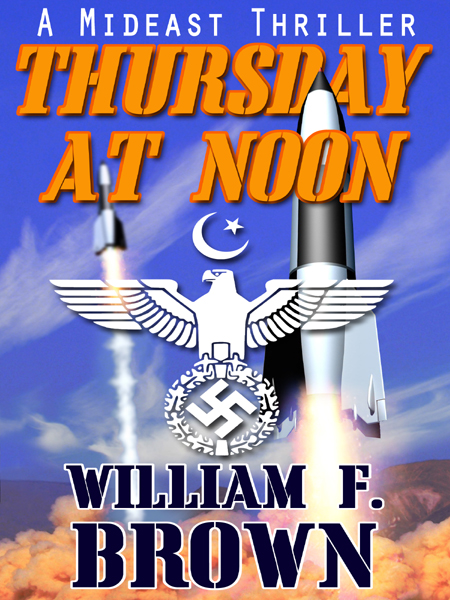
Thursday At Noon - William F. Brown


    2012; 278 pages.  New Author? : Yes.  Genre : Action; Intrigue.  Overall Rating : 7½*/10.

    Things have been rough lately for Agent Thomson.  There was the fiasco in Damascus for which he has been given the blame.  Now all his younger cohorts at the Cairo CIA office snicker at him, and the US Ambassador to Egypt is just waiting for an excuse to ship his over-the-hill butt home.

    So when a local Egyptian approaches him in a bar with the offer to sell him some important photographs, Thomson recognizes it as a scam and refuses to pay.  But when the Egyptian is shortly thereafter beheaded right outside Thomson’s hotel, he realizes that he may have missed an opportunity to redeem his career.  How can things get any worse?

What’s To Like...
    The action is non-stop, and the prologue (the chapters before we meet Thomson) will draw you instantly into the book.  Thomson makes for a fine anti-hero – he drinks too much, gets beat up a lot, and makes wrong decisions.  He also is quite the wit, which adds lends a nice “flavor” to the action.

    The setting – Cairo - feels “real” to me; although granted, I’ve never been to the Mideast.  The 1962 mindsets are also well done, and I am old enough to remember Egyptian and Israeli sentiments in those days.

    It’s both rare and nice to see an author working some Arabic into the text.  And it’s both rare and refreshing to see Abdel Gamal Nasser (and even a second Egyptian official), portrayed in a positive light.  The Israelis are not perfect either, although it has to be said the overall tone here is more pro-Israel than pro-Egypt.  There’s only one female character in the book, so the love angle is pretty easy to foresee.

    The storyline builds to an exciting climax, with only a couple WTF moments along the way.  At one point, a bound-&-gagged Thomson somehow saves the day.  At another, a patient who’s been hypodermically drugged, is revived by throwing some water in his face.  I don’t think it’s quite that easy to overcome chemistry.  OTOH, compared to a Dirk Pitt novel, TaN’s WTF moments are few and far between.

Excerpts...
    The small cab heeled over and Thomson braced himself, grabbing the door handle for dear life as the small cab sped on into the city’s Old Quarter.  It had once been ringed by sixty massive stone gates, but only three of them had survived.  It was common knowledge that the Cairo cab drivers had probably knocked down the other fifty-seven, and inciting one of these drivers to speed and drive recklessly was both redundant and suicidal.  (loc. 2315)

    “There is no CIA plot.”
    “There is always a CIA plot.”
    “You’ve got the CIA on the brain, Captain.”
    “I admit to certain prejudices, but history shows your country never tires of meddling with little people like us.”  (loc. 2403)

Kindle Details...
    Thursday At Noon sells for $2.99 at Amazon.  William F. Brown has three other novels available for the Kindle, all of which are also $2.99.  For some reason those other books don’t show up on Amazon’s “William Brown Author’s Page”, but you can see them in the “Customers Who Bought This Item Also Bought” section.

“Ah, those Cairo nights, full of mystery and sin.”  Bullshit, Thomson thought.  (loc. 592)
    There are some weaknesses.  All of the characters are either “black” or “white”.  This makes it easy to figure out what’s going on and who’s behind it.  It also means that there are very few plot twists that “gray” characters inherently cause.

    There aren’t a lot of typos, but three prominent ones – hangar/hanger, Luger/Lugar, and Frankfort/Frankfurt are curious in that William F. Brown gets each of them correct about half the time.  Random guessing?  I’m also surprised that spell-checker allows “Lugar”.

    Overall, I found Thursday At Noon to be a well-told page-turner, with a nice blend of action, history, wit, love, and intrigue.  Seeing Nasser portrayed as a man of honor and integrity was a pleasant surprise; and it was also a timely read, given the current unrest in Egypt.

    7½ Stars.  There are a couple loose ends (Collins, Ilsa) still hanging at the story’s end, but perhaps this is deliberate so things can segue into a sequel.