2011;
216 pages. New Author? : Yes. Genre : Epic Fairytale. Overall Rating : 7½*/10.
The
Wizard (Magician,
actually) Bodolomous wants to be the Most Evil Person Ever. The Princess Willuna wants to learn how to be
serious so King Anisim will marry her.
The Farmer, Idwal, just wants to live a dull, normal life and avoid
adventure at any cost.
Some of them achieve their goals, but not necessarily in the manner they
expected. Some of them fail miserably at
their goals. All of them get swept up in
an epic Fairytale.
What’s To Like...
In
a nutshell, The Wizard, The Farmer, and the Very
Petty Princess is a 200-page, fun-to-read fairytale. It borrows elements
from a number of other works – Monty Python’s Holy
Grail (“how
do you know she’s a witch?”), The Wizard
of Oz (characters
searching for what they lack), and several classic fairytales. But the story itself goes its own way; there's nothing stale or boring here.
The characters aren’t very deep, and gifts like magic fiddles and magic
bows-&-arrows pop up when needed. But
that’s the norm in fairytales. Face it, Little
Red Riding Hood is a shallow character, and Cinderella's mice and pumpkins are conveniently at hand to be changed into horses and carriages.
A
number of the chapters start off with “If you were to ask so-&-so if this
story was about her…”, and end with “And that was how so-&-so learned
such-&-such”. I found that both novel and neat.
Everything builds to a nice storybook ending. This is a standalone story, although I could
see the characters having further adventures in sequels. There also could be a prequel, as reference
was made to the “human wars” occurring 40 years earlier, but ANAICT, this never
figured into the plotline.
Excerpts...
Bodolomous
peered over the castle’s wall. Below
them the city spread out down the hill.
People below celebrated – making fireflies of themselves with sparklers,
making themselves hyenas with their laughter, some of them making themselves
pregnant with regrettably ugly people and a great deal of ale. The wizard sniffed. He had been one of them, once. “Noisy”, he said, his voice all disdain. (loc. 703)
Anisim smiled. “You’re a vision when you’re breaking things.”
“I think I’ve found my calling. And you, good sir, maybe you’ll get to hang
up your sword for just a little while. I
heard you cut off your father’s head by the way, how did that go?”
“Go?
It went off and to the left.” (loc.
3509)
Kindle Details...
The
Wizard, The Farmer, and the Very Petty Princess sells for $3.99
at Amazon. ANAICT, this is Daniel Fox’s
only book there.
“I won’t have somebody mucking up my bid for infamy. Off with you now.” (loc. 1027)
There is a review at Amazon wherein the writer
says that, while this is a good book, she found it inappropriate for her
12-year-old. I am frankly
dumbfounded. There is no sex, drugs,
cussing, or even alcohol in the book.
There are one or two references to Snow-Drop’s “boobs”, but that’s the
worst I can remember. Really, lady? You think your tweener can’t handle
that? Wow.
TWTF&TVPP is a pleasant, light read that both
adults and kids will like. It isn’t
deep; it doesn’t take itself too seriously.
But it is entertaining, despite being “just” a fairytale. That’s a worthy accomplishment by Daniel Fox. 7½ Stars.
1990;
250 pages. New Author? : No. Book #16 (out of
20) in the Brother Cadfael Chronicles.
Genre : Murder-Mystery; Cozy. Overall
Rating : 8*/10.
After
a 7-year pilgrimage to the Holy Land, William of Lythwood and his young apprentice,
Elave, have returned to Shrewsbury, only to find themselves both accused of
heresy. William takes this
stoically. After all, he is dead and in
a casket. All the heresy charge does is
determine whether he will be buried within the grounds of the abbey.
But
for Elave, the price may be higher. And
there are three witnesses against him, including the lovely Fortunata. He admits the testimony against him is true,
and is unrepentant. But when one of the
witnesses turns up dead, Elave finds himself incarcerated on suspicion of murder, as well as heresy.
What’s To Like...
The Heretic’s Apprentice, Ellis Peters’ 16th
book in the series, has a somewhat different template. Brother Cadfael does very little “solving”
here, mostly he is just along for the ride as Brother Anselm, Fortunata, and the sheriff do the sleuthing. And atypically enough, Elave
is eliminated as a murder suspect somewhat quickly.
But that doesn’t detract from the story.
There is still the matter of who done it and why they done it. You’ll walk beside Cadfael and Sheriff Hugh
as the prime suspicion bounces around.
It wouldn't be a Brother Cadfael story without a romance, of course. This time the
stumbling block is the charge of heresy against Elave. There is also a lot of backstory. The murder isn’t discovered until we’re more
than 40% through the book.
As
always, the real joy of reading a Brother Cadfael story (besides the mystery) is Ellis
Peters’ ability to create a believable 12th-century setting. Everything “feels” right for June, 1143,
including the people, the mindsets, the town, and the terrain. If you like historical fiction, Edith
Pargeter/Ellis Peters is the author for you.
Kewlest New Word…
Caparisoned (adj.) : clothed
in finery (especially,
a horse)
Excerpts...
“The good who go astray into wrong paths do more harm than
the evil, who are our open enemies,” said Canon Gerbert sharply. “It is the enemy within who betrays the
fortress.”
Now that, thought Cadfael, rings true of
Church thinking. A Seljuk Turk or a
Saracen can cut down Christians in battle or throw stray pilgrims into
dungeons, and still be tolerated and respected.
But if a Christian steps a little aside in his beliefs he becomes
anathema. (pg. 29)
“I will not bow to such superstitious foolishness. It would be to encourage the madmen, and put
other souls in worse danger than mine.
This I don’t believe can come to anything perilous, if I stand my
ground. We have not yet come to that
extreme of folly, that a man can be hounded for thinking about holy
things. You’ll see, the storm will pass
over."
“No,” she insisted, “not so easily. Things are changing, did you not smell the
smoke of it even there in the chapter house?” (pg.
89)
“What are wits for ... unless
a man uses them?” (pg.
76)
If
there’s a weakness to The Heretic’s Apprentice,
it lies in the details of the heresy charges against Elave. Ellis Peters brings up a slew of Augustinian
issues – infant baptism, original sin, grace-vs.-works, free will vs.
predestination, and something called the Patripassian Heresy. These are all worthy topics, but it feels
clunky as she tries to squeeze them all into the story. The grand finale – the heresy trial itself –
feels rushed, and I found its key arguments to be non-persuasive.
The more subtle theological issues here – dying with un-confessed sins
and renouncing one’s unorthodox beliefs – are done with a much defter touch. But I kept wondering just how realistic
these dogma debates were for that time period, especially among the common folk.
Kudos
to Ms. Peters for the ambitious attempt to address some weighty theological
issues here. She didn’t quite get the
clunks out, but that doesn’t change the fact that the plusses of The Heretic’s Apprentice far outweigh
the minuses. 8 Stars.
2012;
278 pages. New Author? : Yes. Genre : Action; Intrigue. Overall Rating : 7½*/10.
Things
have been rough lately for Agent Thomson.
There was the fiasco in Damascus for which he has been given the
blame. Now all his younger cohorts at the
Cairo CIA office snicker at him, and the US Ambassador to Egypt is just waiting
for an excuse to ship his over-the-hill butt home.
So
when a local Egyptian approaches him in a bar with the offer to sell him some
important photographs, Thomson recognizes it as a scam and refuses to pay. But when the Egyptian is shortly thereafter
beheaded right outside Thomson’s hotel, he realizes that he may have missed an
opportunity to redeem his career. How can
things get any worse?
What’s To Like...
The action is non-stop, and the prologue (the chapters before we meet Thomson)
will draw you instantly into the book.
Thomson makes for a fine anti-hero – he drinks too much, gets beat up a
lot, and makes wrong decisions. He also
is quite the wit, which adds lends a nice “flavor” to the action.
The setting – Cairo - feels “real” to me; although granted, I’ve never
been to the Mideast. The 1962 mindsets
are also well done, and I am old enough to remember Egyptian and Israeli
sentiments in those days.
It’s both rare and nice to see an author
working some Arabic into the text. And
it’s both rare and refreshing to see Abdel Gamal Nasser (and even a second Egyptian official),
portrayed in a positive light. The
Israelis are not perfect either, although it has to be said the overall tone
here is more pro-Israel than pro-Egypt.
There’s only one female character in the book, so the love angle is
pretty easy to foresee.
The storyline builds to an exciting climax, with only a couple WTF
moments along the way. At one point, a
bound-&-gagged Thomson somehow saves the day. At another, a patient who’s been
hypodermically drugged, is revived by throwing some water in his face. I don’t think it’s quite that easy to
overcome chemistry. OTOH, compared to a
Dirk Pitt novel, TaN’s WTF moments are few
and far between.
Excerpts...
The
small cab heeled over and Thomson braced himself, grabbing the door handle for
dear life as the small cab sped on into the city’s Old Quarter. It had once been ringed by sixty massive stone
gates, but only three of them had survived.
It was common knowledge that the Cairo cab drivers had probably knocked
down the other fifty-seven, and inciting one of these drivers to speed and
drive recklessly was both redundant and suicidal. (loc. 2315)
“There is no CIA plot.”
“There is always a CIA plot.”
“You’ve got the CIA on the brain, Captain.”
“I admit to certain prejudices, but history
shows your country never tires of meddling with little people like us.” (loc.
2403)
Kindle Details...
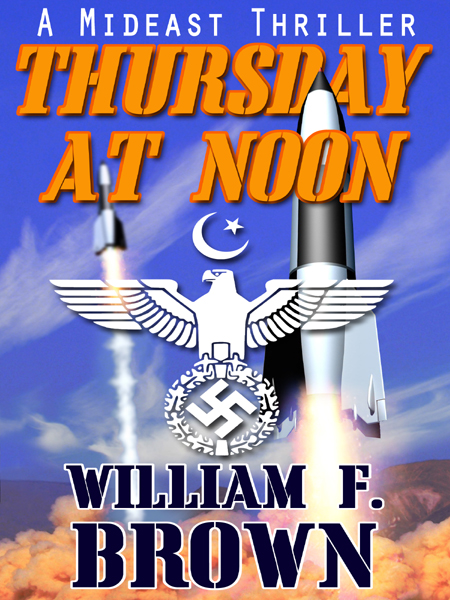
Thursday
At Noon sells for $2.99 at Amazon. William F. Brown has three other novels
available for the Kindle, all of which are also $2.99. For some reason those other books don’t
show up on Amazon’s “William Brown Author’s Page”, but you can see them in the “Customers Who
Bought This Item Also Bought” section.
“Ah, those Cairo nights, full of mystery and sin.” Bullshit, Thomson thought. (loc. 592)
There are some weaknesses. All of the characters are either “black” or
“white”. This makes it easy to figure
out what’s going on and who’s behind it.
It also means that there are very few plot twists that “gray” characters
inherently cause.
There
aren’t a lot of typos, but three prominent ones – hangar/hanger, Luger/Lugar,
and Frankfort/Frankfurt are curious in that William F. Brown gets each of them
correct about half
the time. Random guessing? I’m also surprised that spell-checker allows
“Lugar”.
Overall, I found Thursday At Noon to
be a well-told page-turner, with a nice blend of action, history, wit, love,
and intrigue. Seeing Nasser portrayed as
a man of honor and integrity was a pleasant surprise; and it was also a timely read,
given the current unrest in Egypt.
7½ Stars. There are a couple loose ends (Collins, Ilsa)
still hanging at the story’s end, but perhaps this is deliberate so things can
segue into a sequel.
2000;
483 pages. New Author? : No. Book #7 in the Culture
series. Genre : Science Fiction. Overall Rating : 8½*/10.
Mahrai
Ziller is both a brilliant Chelgrian composer and one of Chel’s foremost
revolutionaries. (Think ‘Ignacy Paderewski'). But he has been in self-imposed exile for
many years, living on the Masaq’ Orbital in the Culture Empire, which chafes
Chelgrian pride.
Therefore Major Quilan is dispatched to travel to the Masaq’ Orbital and
to convince Ziller to return home. Ah,
but there are ulterior motives for his visit.
Quilan’s been told about them, then had his memory banks modified to
where he’ll only gradually recall those further plans at the appropriate times.
What’s To Like...
As
with any Iain M. Banks novel, the world-building (universe-building, actually) is
incredibly detailed and believable. There’s
a planet-sized ring instead of the usual sphere. The robotic drones have personalities; and
the foxlike Chelgrians and 9-foot tall Homomdans mingle with the humans. If you liked the two-heads/one-body setup for
Rand and Lews in WoT, you’ll find Quilan and Huyler similarly fashioned.
There’s
a certain somberness to Look To Windward,
but it’s balanced by some witty dialogue, strange creatures, and fascinating
sentient beings. Ziller is great; so is
the scholar Uagen Zlepe. Then there’s
the names of the spaceships, such as “Resistance is Character Forming” and “Experiencing a
Significant Gravitas Shortfall”.
The gradually-revealed scheming is a clever device.
Iain
M. Banks explores a number of themes in LTW,
including revenge, euthanasia, religion, and the caste system. There is a small amount of critter sex and
some adult language, but only prudes will be bothered by it.
Kewlest New Word...
Trefoil (adj.) : In a clover-like or lotus (sitting) position.
Excerpts...
“Of course, this is always assuming that
none of your ship Minds were lying.”
“Oh, they never lie. They dissemble, evade, prevaricate, confound,
confuse, distract, obscure, subtly misrepresent and willfully misunderstand
with what often appears to be a positively gleeful relish and are generally
perfectly capable of contriving to give one an utterly unambiguous impression
of their future course of action while in fact intending to do exactly the
opposite, but they never lie. Perish the
thought.” (pg. 29)
“There are those who believe that after
death the soul is recreated into another being.”
“That is conservative and a little stupid,
certainly, but not actually idiotic.”
“And there are those who believe that, upon
death, the soul is allowed to create its own universe.”
“Monomaniacal and laughable as well as
probably wrong.”
“Then there are those who believe that the
soul--“
“Well, there are all sorts of different
beliefs. However, the ones that interest
me are those concerning the idea of heaven.
That’s the idiocy it annoys me that others cannot see.”
“Of course, you could just be wrong.”
“Don’t be ridiculous.” (pg. 275)
“Tonight you dance by the
light of ancient mistakes!” (pg.
10)
There
isn’t a lot of action in Look To Windward
until the very end, and even then it isn’t of epic proportions. This makes for some slow spots as Banks gradually develops the plotline and pauses to spend time on numerous topics.
OTOH, the darker side of The Culture is revealed here. Their benevolent meddling does not always
work out as planned, and if you cross them seriously enough, they have some brutal
ways of dealing with you.
This is my third Iain M. Banks book (the other two are reviewed here and
here), and I am beginning to see a pattern.
The storylines are not on a particularly cosmic scale, but the worlds
and creatures he creates are eminently believable and richly developed; and he
addresses various topics, particularly ethical ones, in a thought-provoking way
that keeps the reader’s rapt attention.
Add to that his obvious writing skills, and you can see why he was one
of the top-tier contemporary sci-fi authors.
Iain M. Banks passed away on 09 June 2013, at the too-young age of
59. He will be sorely missed. 8½ Stars.
2012;
200 pages. New Author? : Yes. Genre : Slacker Noir. Overall Rating : 7½*/10.
Poor
Ethan. He goes down to La Fogata, his
favorite place for tacos, and who does he run into? His ex-GF, aka “The Girl Who Got Away”.
With her new flame, aka “Lesser
Me”. But what really hurts is the fact
that Ethan considers La Fogata to be his taco joint. The ex and her boy-toy should find their own
Mexican food dive.
Ethan gives them his best parting zinger (“This place is better than butt-sex”),
and exits semi-gracefully. Unfortunately, somebody
murders the couple later that night, and Ethan has only the flimsiest of an alibi. Which makes hard-assed Detective Boyd of the LAPD certain that
Ethan is guilty. And Boyd won’t rest until he’s extracted a full confession out
of Ethan.
What’s To Like...
There’s
a double-murder, and a mystery as to whodunit.
But this really isn’t a Murder-Mystery.
It’s more of a contemporary fiction novel about Ethan, and how he copes
with women, work, and an insane world.
Michael Estrin writes in a style that is both witty and convincing. But be forewarned – Murder & Other
Distractions is R-Rated from the first page – both in language and in content. It works nicely (what would you expect from the Slacker
Noir genre?), but this is not a book for the prudish.
Ethan
is nicely developed as an anti-hero. He’s
not really great with the ladies; work is little more than seeing how long he
can avoid being laid off; and his friends tolerate him more than they like
him. He’s a classic slacker and an
obvious suspect. But he and Detective
Boyd develop an unlikely kinship as the story progresses.
But for me,
the best part of the story is Michael Estrin’s portrayal of Los Angeles. I lived in the greater LA area for three
summers, and there’s something pitch-black and oily and evil-feeling about the
city. The author catches this ambiance
perfectly. It brought back some
delightfully dark memories.
Excerpts...
The
Internet is no place for an existential crisis.
Being connected to everyone and everything ought to be
illuminating. The truth is, it’s madness
– a tower of babble moving at the speed of light, and there’s no way off the
mountain. (loc. 588)
“You want to know the difference between
men and women?” Zeiger asks his class, which is nearly all female. “Here’s the thing. We all want $100. Women look at life and they search for that
one Benjamin – the perfect guy. Men, on
the other hand, will take all the dirty singles they can get.” (loc. 797)
Kindle Details...
Murder
and Other Distractions sells for $2.99 at Amazon. AFAIK, this is Michael Estrin’s debut
offering at Amazon.
“Los Angeles is a car town.
Like a Disney ride, it’s best if you keep your arms and legs safely
inside the vehicle.” (loc. 639)
If there’s a weakness to Murder and Other
Distraction, it’s the storyline itself. Estrin’s
wit and insight is a joy to read, but sooner or later you start craving an
exciting, or even just a coherent plot. The
Who of the whodunit is completely arbitrary, which will leave mystery readers
disappointed. And while I thoroughly
love the way Estrin “catches” the essence of LA, if you’ve never lived or
visited there, you may get tired of the countless references to various
neighborhoods and streets.
So
let’s give M&OD 7½ Stars. It’s
a tantalizingly good debut effort. If
Michael Estrin learns to drape his writing skills around a gripping plotline,
he’s going to have a great and long-lasting writing career.
2002;
339 pages. New Author? : No. Genre : Comedy; Contemporary Fiction. Overall Rating : 9*/10.
Welcome
to Higby, Mississippi. It’s Labor Day weekend 1993, and the townsfolk are making
plans to relax by throwing Tripoley parties, playing Stratego, and perhaps
making a macaroni painting. Of course, a
little bit of alcohol helps liven up any of these activities.
But
things are amiss in Higby. Carmen
Valentine’s invisible guardian angel has just left on a 2-week vacation, and Clint
Cullen has taken a dive from atop the rickety water tower into a swimming pool. He’ll
live, but the weekend is only going to get wackier.
What’s To Like...
You’ll
find Welcome To Higby in the Humor section
of your bookstore, and it certainly delivers.
But on a deeper level, it’s a series of stories about dysfunctional
Love. There are tired relationships,
lost loved ones, people scared of a relationship, and those who are seeking Divine Love. For the most part,
those searching for love find it, but rarely in the manner they expect.
You’ll
meet a couple dozen of the local residents, and trying to remember who’s
related to and/or seeing who is a challenge.
You can take notes if you want, but things soon coalesce into about 5
storylines. The characters come in
various colors, natures, and political and religious mindsets. Like snowflakes, no two of them are
alike. You’ll find them all likeable,
even the Brothers and Sisters of the Blessed Redeemer. And if you see Muffin, she with the Wayward
Steak, please try to catch her.
Mark Dunn does a superb job of interweaving the humor with the various
plotlines. The chapters are short, which
keeps the pace hopping; and each one opens with a snippet of Scripture,
which then gets played out in the chapter in a most unforeseen manner. The books wraps up nicely, with all of the
major plotlines tied up. A thoroughly enjoyable read.
Excerpts...
“Just look at him.”
“Look at who?”
“Hank. He’s right down on his hands and knees
tellin’ your cat all about Jesus Christ of Nazareth.” Nancy Leigh set down her bottle of Windex and
turned to Bowmar. “This doesn’t bother
you the tiniest little bit?”
“I don’t think it would be such a bad
thing, Nancy Leigh, if my cat happens to wind up in Heaven.” (pg. 7)
Talitha noticed that Joy was still holding the letter for
Nancy Leigh in her hand. Pud had read it
first and struck through two lines that he felt might be a little
alarmist. “Help! Help! I’ve been kidnapped by a religious cult
and am being brainwashed even as you read this!” and “There are bloodthirsty
Doberman pinchers who will eat me alive if I try to escape!” At first Pud had merely been troubled by the
misspelling of the word “pinschers.”
Then he had second thoughts and scratched through the whole sentence
before passing the letter along to Joy. (pg.
178)
“We’re all human, when you
come right down to it.” (pg.
110)
The
story may be set in Mississippi, but it brought back some fond personal childhood
memories of growing up in a small town (pop. 200) in Pennsylvania. It was a simpler time, moving at a slower
pace, and life’s issues seemed less complex way back then.
Overall,
Welcome To Higby has the tone and “feel” of
Edgar Lee Masters’ Spoon River Anthology,
but with the characters much more fleshed out.
Then mix in some crazy and convoluted plot twists like you’d find
in one of P.G. Wodehouse’s Jeeves novels. If you like those two authors, you’ll
enjoy WTH.
One thing to note – there are adult situations and language here, so
this is a spicier read.
9 Stars. Highly recommended. Subtract one star if you’ve never lived in a small town,
or if you’re too young to remember fax machines and lint-removal rollers. You don’t know what you've missed.
2012;
212 pages. New Author? : n.a. Genre
: Anthology; Speculative Fiction. Overall
Rating : 7*/10.
18
short stories about various creatures, most of which have either gone extinct or
are about to become so. There are
dinosaurs and cave bears; ghosts and aliens; Neanderthals and angels. There is romance and humor; tragedy and
sci-fi; new beginnings and post-apocalyptic endings.
In
short, there’s something for everyone here.
What’s To Like...
The stories are grouped in somewhat chronological order. That gives a bit of structure to the Extinct Doesn’t Mean Forever, although it also
means you’ll be reading all the dinosaur stories more or less together. A lot of the authors seem to be from Australia,
which gives parts of the book a refreshing Down Under “flavor”.
The
Amazon blurb for this book gives a one-line teaser for each story; I won’t
repeat those here. As with any
anthology, I found some of the stories to be riveting; others were yawners. You're entitled to form your own opinion about which ones are the yawners, so I'll content myself with listing a couple that I thought were the
cream of the crop.
(01) Last Seen
(Amanda le Bas de Plumetot)
A
powerful story about the recently-extinct thylacines to lead things off. My favorite of the bunch.
(02) Past
Survivors (Sarah Adams)
Both saber-tooth tigers and relationships are hiding in the hills around Los Angeles.
(15) Blood
Fruit (Shona Snowden)
Mankind’s hope hangs by a thread.
That's not good news when Vin and Levo are holding the thread.
(16) A Thorny
Dilemma (Rory Steves)
Bio-engineering gone wrong. So
why am I chuckling?
(17) Invoice
H10901: 3 Wooly Mammoths (Robert J. Sullivan)
Parallel worlds meet the Law of Supply and Demand.
Excerpts...
The
last thylacine died in the Hobart Zoo.
Locked in a cage, she stared out through the lattice of wire to the
distant warmth of the keeper’s house.
Alone all the long nights, she paced, fretful, the unfamiliar sound of
her nails clicking on cement. She was
surrounded by the stink of bears, the roar of lions, the shit-hurling culture
of monkeys, the press and flow of humans.
The last thylacine was imprisoned between concrete floor and iron bars
without even a kennel’s shelter. (loc.
100)
“Do you remember the Angel Genome Project?”
God,
not again. She opened a financial
report on her computer and stared at the numbers without really seeing
them. “Yes. What about it? They were going to sequence the genome of
whatever it was they found in Iran.
Angels, they said. We’ve got the
mammoth parks and the Neanderthal town.
Let’s clone angels, have ourselves a park with cherubs, a
wish-fulfillment fantasy with merry-go-rounds and everything.”
“Such a cynic, girl. You used to believe in science.” (loc. 1585)
Kindle Details...
Extinct
Doesn’t Mean Forever sells for $0.99 at Amazon. ANAICT, this was Phoenix Sullivan’s first
stab at editing/compiling an anthology.
She also has an eclectic triad of her own books on Amazon.
“What does mankind do with endless power and no boundaries?”
(loc. 2688)
As seen in the “best of” choices given above, my favorite parts of EDMF’s were at the beginning and near
the end. That speaks well of
Phoenix Sullivan’s effort as the editor.
Having two stories about the thylacine tiger seemed a bit redundant, but
maybe I’d feel different if I was an Aussie.
I
have to believe that trying to write a gripping tale of speculative fiction in a scant 10-20 pages is
quite the challenge. World-building and
character-development have to be done quickly and efficiently. Some of the writers were more successful at
this than others, but kudos to all of them for giving it a try. 7 Stars.
1998;
378 pages. New Author? : No. Book #23 in the Discworld
series. Genre : Comedic Fantasy. Overall Rating : 8*/10.
Plans
are being made for the naming ceremony of the newest addition to the Lancre
royal family, and King Verence and Queen Magrat are sending invitations to all
sorts of people in the surrounding lands.
The witches are invited because, well, Magrat used to be one of
them. The ruling Vampire family
from neighboring Uberwald are also invited. Is it really
a good idea to invite vampires into one’s realm? They are sort of, well you know, sucky
creatures. Oh well, we’ll just have to
trust they’ll behave.
Now whatever happened to Granny Weatherwax’s invitation?
What’s To Like...
The
Discworld witches take center stage here, and that’s always a treat. There’s also an Igor, DEATH, and the initial
appearance of the Nac Mac Feegle in a Discworld novel. But that’s about it for familiar faces, since
the story is set in Lancre and Uberwald, two places far removed from Ankh
Morpork. But we get to meet lots of new
folks, including the Magpyr family, rulers of Uberwald, who wish to expand
their horizons.
Carpe Jugulum appears to be Terry Pratchett’s
endeavor to combine Undead Horror with Discworld Spoofery, which frankly is no
small challenge. I can’t think of
another Discworld novel where I’ve actually worried for the safety of some of
its heroes. As usual, there are other
themes.
Urban Legends. Pratchett has
loads of fun with anti-vampire weapons – garlic, holy water, wooden stakes,
and whatnot. Sometimes they work; sometimes they
don’t.
Inner Voices. The full-figured
witch, Agnes Nitt, and her “thin woman trying to get out” have a major role
her. Indeed, all the witch characters
are more fully developed than usual.
Organized Religion vs. Paganism. Or,
Mightily Oats vs. Granny Weatherwax. Actually,
Terry Pratchett puts them on equal footing, and deftly weaves the circumstances
to where they have to work together to defeat the vampires. Very kewl.
Kewlest New Word...
Scry (verb) : To foretell the future using a
crystal ball or other reflective object or surface.
Excerpts...
A movement made her turn. A small blue man wearing a blue cap was
staring at her from the shelves over the washcopper. He stuck out his tongue, made a very small
obscene gesture, and disappeared behind a bag of washing crystals.
“Nanny?”
“Yes, luv?”
“Are there such things as blue mice?”
“Not while you’re sober, dear.” (pg. 80)
Granny Weatherwax had a primal snore. It had never been tamed. No one had ever had to sleep next to it, to
curb its wilder excesses by means of a kick, a prod in the small of the back or
a pillow used as a bludgeon. It had had
years in a lonely bedroom to perfect he knark,
the graaah, and the gnoc, gnoc, gnoc unimpeded by the
nudges, jabs, and occasional attempts at murder that usually moderate the snore
impulse over time. (pg.
366)
“Once people find out you’re a vampire they act as if you’re some
kind of monster.” (pg.
274)
All
the witches are present, but center stage belongs to Granny Weatherwax. She’s up against foes that are stronger,
faster, and probably more intelligent than her.
Their leader, The Count, is able to anticipate her every move, and he
will not be satisfied until Granny has been utterly and permanently defeated. That makes for an exciting ending, albeit one
that is just a tad bit contrived. But
this is Discworld, and ‘contrived’ is often the norm here.
Carpe Jugulum was an entertaining read. The mixing of horror into the storyline means
that this isn’t the zaniest Discworld novel you’ll ever read. Rincewind would never have fit into the
story. Nevertheless, there is sufficient
humor, and the themes are thought-provoking.
8 Stars.
2013;
226 pages. New Author? : Yes. Genre : Dark Fantasy. Overall Rating : 8*/10.
16-year-old
Macy Winters is at death’s door, due to an infection that has developed into
sepsis. The final thing she hears while
lying in the hospital bed is the doctor debating whether to put her in an
induced coma as a last-ditch effort.
The
next moment, she wakes up in a comfortable bed, with two other girls greeting
her by name and welcoming her to the village of Chanticleer. Superficially, it seems like a teenage
paradise. But there are lessons to be
learned, and the place has its dark secrets.
Like sometimes a kid will simply disappear overnight. They say he “tipped back”, but who knows for
sure? And no one wants to talk about the
shells.
What’s To Like...
The target audience for The Shells of Chanticleer are young-teenage
girls, probably up to Macy’s age (16).
As such, there is no sex, cussing, nudity, or violence. There is some Romance, naturally, but it’s limited
to kissing and cuddling.
The storyline is original. The
characters are all well-developed, although a couple of them (Rafe, the Prime
Minister, etc.) seem to have a brief time in the spotlight, then
fade into the background. Bing is
uber-kewl, though. You’re going to enjoy
meeting him.
Macy
is an inquisitive sort, and it’s fun to “walk alongside her” as she tries to
unravel the various secrets of Chanticleer.
There are lots of twists along the way to keep you guessing as to what’s
going on. Macy’s ultimate issue (“Should I stay
or should I go?”) is masterfully resolved, and not in the way I
anticipated.
Excerpts...
“Wow,””
I said. “So you’re saying that I’m a
wimp?”
“Well, I wouldn’t use that word. We are not pejorative here, as a rule. But you are a little unbalanced. What I mean is you need a better blend of
imagination and reality. We don’t want
to see your real potential buried under a lot of imaginary fears and
self-imposed roadblocks and anxieties.” (loc.
681)
“I have to keep playing mud soccer until I
enjoy it,” she said. “And I hate
it. Hate. It.
Did you have fun?”
“I liked it,” I said. “Mud comes right off. It’s no big deal.”
“Yes it is,” Zooey insisted. “It’s full of microbes and germs and deceased
insect particles and larvae and cricket casings. It’s horrid.
By the way, you need to put those clothes in a plastic bag out in the
hall so someone will take them away.” (loc.
1443)
Kindle Details...
The
Shells of Chanticleer sells for $0.99 at Amazon. At the time of this review, it is Maura
Patrick’s only book at Amazon.
“It’s Chanticleer, a benevolent world, though it might not always
seem so.” (loc. 971)
There are a few inconsistencies towards the
end of The Shells of Chanticleer. Macy’s final challenge is quite the
paranormal romp, which contrasts to all her humanly-contrived challenges up to
that point. Also, the history of
Chanticleer is partially revealed, but gaps remain and there are some pesky loopholes
in the logic.
We’ll skip the details due to spoiler concerns, but give props to Maura
Patrick for not being afraid to address the whys
and wherefores of the place. And I frankly doubt that YA girls who read
the book are going to get hung up on the world-building mechanics.
I
found the pacing and storytelling of TSoC to
be excellent. Despite not being the
target age or gender for the book, it was a page-turner for me. Perhaps more of the Chanticleer’s
history/mystery will be dealt with in a sequel.
8 Stars. Add a half-star if you’re a girl, and another half-star
if you’re aged 12-15.