Showing posts with label techno-thriller. Show all posts

Friday, May 30, 2025

Project Daedalus - Thomas Hoover

   1991; 368 pages. New Author? : No, but it’s been a while.  Genres: Technothriller; Action-Intrigue.  Overall Rating : 7*/10.


    Sometimes money laundering can be in the best interest of both parties.


    For instance, if a sovereign nation, such as Russia, wants to finance a cutting-edge technological research project at a powerful private-enterprise industrial corporation in a different country, such as Japan, it’s best for all concerned that nobody else knows about it.


    One common method is to convert millions of dollars into something called debentures, loan certificates that are unsecured.  Pass them through a couple of rounds of unscrupulous bankers’ hands so they can’t be traced, then to the intended receiver, and make sure everybody keeps their mouths shut.


    Alas, things go haywire if those debentures disappear during one of those banking handoffs.  If those certificates aren’t found, and in a hurry, heads will roll.  Literally.  But where are we going to find someone with experience in prying into clandestine operations?


    How about an ex-CIA agent, Michael Vance, Jr.?


What’s To Like...

    There are two main storylines in Project Daedalus: our protagonist, Michael Vance, tries to figure out where the debentures went; and an aerospace corporation works at developing a plane (as shown above in the book cover) that can achieve “hypersonic” speeds of Mach 25 or so.  Eventually the two plot threads converge, setting up an exciting climax.


    I enjoyed the various settings.  We start out in Athens, Greece, with a visit to nearby Knossos, Crete.  We also spend time in London, where the money-laundering shenanigans are taking place; and Hokkaido, Japan, where the plane testing is underway.  And let’s not neglect to mention several goosebump-raising trips into the upper atmosphere.  All these places felt “real” to me.


    The book was written in 1991, and I chuckled at some of the now-obsolete items.  Messaging was done by telex, and decryption efforts were done via a cutting-edge technological device (for that era): a Lotus spreadsheet program on a 486 computer.  I also liked the mention of the cosmonaut Yuri Gagarin, and was wowed when a plane did a “Mach 3 Immelmann maneuver”.


    Everything builds to a sustained, nail-biting ending.  You might have the fastest plane ever, but that doesn’t mean you can’t be brought down by missile-shooting enemy fighter planes and/or the excessive-heat conditions of the atmosphere.


Ratings…
    Amazon: 4.2*/5, based on 159 ratings and 48 reviews.

    Goodreads: 3.50*/5, based on 193 ratings and 11 reviews.


Excerpts...

    To begin with, members of the intelligence services of major nations didn’t go around knocking each other off; that was an unwritten rule among spooks.  Very bad taste.  Maybe you tried to get somebody to talk with sodium pentathol [sic] or scopolamine, but guns were stupid and everybody knew it.  You could get killed with one of those things, for godsake.  (loc. 2148)


    He slipped off the shirt he’d been wearing in London, happy to be rid of it, and put on the first half of the uniform.  Not a bad fit.  The trousers also seemed tailor-made.  Then he slipped on the wool topper, completing the ensemble.

    “You would make a good officer, I think.”  Andrei Androv stood back and looked him over with a smile.  “But you have to act like one too.  Remember to be insulting.”  (loc. 6585)


Kindle Details…

    You can pick up Project Daedalus for free at Amazon right now.  In fact, the other eight e-books Thomas Hoover has tout here are also free.  I suspect this is a “for a limited time only” deal.


“If a man owes you a hundred dollars, you have power over him; if he owes you a million dollars, he has power over you.”  (loc. 4250)

    There’s a fair amount of cussing in Project Daedalus; I counted 18 instances in the first 10% of the book, including three f-bombs.  There are several rolls-in-the-hay to boot, since Vance crosses paths with an ex-lover along the way.


    There were also a fair number of typos, such as Vanced/Vance, wastin/wastin’, and numerous missing quotation marks.  One recurring error involved the name of the prototype aircraft, “Daedalus I”, which the conversion program often mistakenly rendered as “Daedalus /”.


    I’m always happy when words and phrases in foreign languages show up in the text.  Here, lots of Russian, Japanese, and Greek vocabulary was used, which I liked, but they are not languages I’m proficient in.  It would’ve been nice to have translations supplied via footnotes or a glossary.


    The main issue though, which several other reviewers also pointed out, was the abundance of technical jargon.  Yes, Project Daedalus is aptly marketed as a “technothriller”.  Yes, that implies there will be passages explaining technical stuff.  But here, those passages are so lengthy, and pop up so often that it slows down the pacing.  And let’s keep in mind, Mach 25 is an impossible speed for an aircraft in Earth’s atmosphere.  The technical details about it are all fictional.


    Despite that, I enjoyed Project Daedalus.  I skimmed through those technical speedbumps (what the heck is a “scramjet” anyway?), and refocused when the text got back to advancing the storyline.  There was lots of Action-&-Intrigue to keep me turning the pages, and I was impressed that the Japanese and Russian characters, of which there were many, were portrayed as three-dimensional human beings, not cookie-cutter stereotypes.


    7 Stars.  One last thing.  If you look in the Table of Contents, you’ll find there’s an entire chapter missing – Chapter 7.  Now, I know of at least one author who does such a thing; he simply eschews Chapter 13 in any of his books.  And to be fair, I don’t think the chapter is truly missing.  It’s just a counting glitch.  Still, what are the odds of this sort of oversight?

Friday, April 7, 2023

Simple Simon - Ryne Douglas Pearson

   1996; 250 pages.  Book 4 (out of 5) in the “Art Jefferson Thriller” series.  New Author? : Yes.  Technothriller; Movie Tie-In.  Overall Rating : 7*/10.


    How do you test a new encryption system?  Well, you could give a coded message to all your geeky IT guys who weren’t part of its development team and challenge them to try to bust it.


    But the head of Comsec-Z, the folks that spent the last five years and ten billion dollars of Uncle Sam’s money creating the new system (called KIWI), wants a more robust round of testing.  After all, KIWI is slated to be used throughout the United States federal government for all sensitive communications.


    Hey, why not try it out in a puzzle magazine?  Insert an encrypted message into one of the editions, with a secret message.  Have it say something like: “You’ve solved Puzzle 99!  Call this number (insert a private Comsec-Z telephone number here) to claim your prize!”  Then just have someone monitor that phone in case it rings.  It won’t, of course.  But still.


    That phone number has been routed to the desk of Leo Pedanski, a cryptographer for Comsec-Z.  As expected, it’s never rang.  So far.


    Leo Pedanski is about to have the worst day ever in his long career at Comsec-Z.


What’s To Like...

    Simple Simon was my introduction to Ryne Douglas Pearson’s 5-book thriller series featuring a black FBI agent, Art Jefferson, and a 16-year-old autistic boy, Simon Lynch.  It’s not a spoiler to reveal that Simon solves the encrypted message in the puzzle magazine and that Art becomes his de facto bodyguard when Comsec-Z reacts unkindly when Simon calls to claim his prize.


    I liked the focus on autism.  We get to hear what Simon hears, see the world as it appears to him, and struggle with his jumbled up thought processes.  Simon’s personal quirks were fascinating.  When writing, he meticulously avoids using the letter “e”, but can’t give you a reason why he does that.  He likes jigsaw puzzles, but only if they have exactly 500 pieces.  Any more or any less, and he ignores them., and he builds those 500-piece ones with all the pieces face down.


    To be honest, I know very little about autism, so I can’t say how accurately it is portrayed, but it gives the storyline a unique tone.  The baddies have formidable resources at their disposal when they come looking for whoever “solved Puzzle 99”, including a psycho assassin from overseas, and Art Jefferson’s task of protecting Simon is made even harder because of the boy’s disorder.


    The ending is okay.  It’s suitably exciting and has a nice twist that allows Simon to finally shake off his pursuers, but the actual showdown between Jefferson and the baddies seemed a bit predictable to me.  The epilogue felt a bit too convenient, although it does reinforce the maxim that karma is a b*tch.


    Simple Simon is a fast, easy read.  Things unfold at a brisk pace, and never bogged down.  The chapters are short, with 26 of them covering 250 pages.  ANAICT, Simon doesn’t appear in the first three books in this series, but Book 5, Simon Sees, is a continuation of Simon's and Art’s relationship.


Ratings…
    Amazon: 4.2*/5, based on 187 ratings and 106 reviews.

    Goodreads: 3.67*/5, based on 352 ratings and 44 reviews


Excerpts...

    He set the cup back on the coaster on the lamp table and cast his eyes to The Tinkery.  They danced over the cover, unwilling to remain still.  There were too many colors, and they bled together so that one color was not itself anymore, and then it was another color.  In his mind’s eye, Simon saw pictures as unbalanced, imprecise, and unsettling.  A picture of a chair was not like looking at a real chair.  The world reduced to two dimensions disturbed him.  (loc. 389)


    It was difficult to think of the man that way with his tongue torn out and one knee bent forward at an impossible angle.  That this…woman had done that frightened Heiji more than a bit.  If only she were tame his thoughts might be of pleasure.

    “Mitsuo, don’t imagine yourself with me,” Keiko said without looking at him.  “Imagination is the second most dangerous thing a man has.”

    Heiji snickered a bit, nervously.  He had been too obvious in his musings.  “The second, is it?”

    “Yes.”

    “What is the first?”

    “A heartbeat.”  (loc. 932)


Kindle Details…

    Currently, Simple Simon sells for $4.99 at Amazon, as do the other four books in the series.  Ryne Douglas Pearson offers more than a dozen other e-books, ranging in price from $1.99 to $4.99, plus two short stories, each costing $0.99.


“Under a tree by a house, by a field washed with rain, lies a boy all alone with his thoughts and his dreams.”  (loc. 132)

    There are a couple of things to quibble about, but nothing major.  I counted only 16 cusswords in the first 20% of the book, which is commendably sparse for a Thriller novel, Four of those were f-bombs.  There’s a racial epithet later on, plus a mention of an erection, and a couple of bouts of torture, but, as shown in the second excerpt above, at least these weren’t lurid.  Still, Wikipedia’s labeling of this as a “Young Adult Novel” seems a bit misguided.


    There were a fair amount of typos.  Hyphen issues, such as “thirty year old”, “mid bite”, “well armed”, and “two handed” were distracting, but maybe this occurs during the document-to-digital conversion.  Others, such as breech/breach, shirt tails/shirttails, and/an, and Arm/arm (twice!), just mean another round of editing ought to be done.


    Overall, Simple Simon was an enjoyable read, although for me, it wasn’t a page-turner.  The plotline seemed predictable, at least up until the aforementioned twist in the ending.  I still recommend it though, particularly for the insight into the challenges of coping with autism.


    7 Stars.  Simple Simon was the basis for a 1998 movie, Mercury Rising, which featured Bruce Willis as the protagonist FBI agent.  Several changes were made in converting from book to movie.  The most obvious was the racial switch of Art from black white, but his last name also went from Jefferson to Jeffries (why??), and Simon’s age dropped from 16 years old to 9 years.  More alterations are listed in its Wikipedia article.


    Mercury Rising grossed $93 million at the box office, but garnered mostly bad reviews, and Bruce Willis “won” the 1999 Golden Raspberry Award for Worst Actor for his performance that year in this and two other films.  I rarely watch movies, but I did watch this one many years ago, and I thought it was quite good, no matter what the critics say.

Tuesday, June 7, 2022

Atlantis Lost - J. Robert Kennedy

   2018; 250 pages.  Book 21 (out of 34) in the “James Acton Thrillers” series.  New Author? : Yes.  Genres: Technothriller; Pulp Thriller.  Overall Rating: 5½*/10.


    It's a good-luck/bad-luck situation.


    While diving in the ocean off the shores of Pico Island in the Azores, Sergeants Carl “Niner” Sung and Jerry “Jimmy Olsen” Hudson find themselves dangerously close to an underwater landslide just as they're running low on oxygen.  Bad luck, guys!


    Ah, but the shifting of the seabed has uncovered what looks like some ancient Roman columns.  That might mean there’s a whole sunken city here, previously undiscovered, and who knows, it could even be the legendary lost city of Atlantis!  What a stroke of good luck!


    Too bad neither Sung nor Hudson know anything about how to excavate a site, especially one under a couple hundred feet of ocean.  Bad luck, guys.  If indeed this is the remains of Atlantis, you might’ve become famous.


    Luckily, you’re pals with a husband/wife team of archaeology professors, James Acton and Laura Palmer.  You can give them a call once you get back to shore, and they can fly over and check out those columns.  There’s nothing wrong with sharing half the fame with them.


    As long as no one else snorkels into the area in the meantime.


What’s To Like...

    The title of the book notwithstanding, the book’s main storyline involves a group of anti-technology, anti-social-media protesters that just happen to also be carrying out their plans in these same waters.  They don’t appreciate the archaeological intruders, and intend to take steps to oust our heroes no matter what.  And although their ideology is ultimately flawed, it appears that J. Robert Kennedy sympathizes with their aims, which I thought was kind of neat.


    The action starts right away, and continues slam-bam throughout the entire book.  Most of the excitement is over-the-top, but if you like Clive Cussler’s Dirk Pitt tales, you’ll love this series.  There are a pair of secondary plotlines: one set in ancient times as Atlantis faces its impending doom (which is not a spoiler; the reader is told this on the first page of the first chapter); the other set in present-day Shanghai.  More about these later.


    As the author notes, although Atlantis is generally considered a myth, Plato makes reference to it in his writings, implying that it had sunk into the ocean centuries before his time.  The truth is, to date no reliable evidence has ever been found of Atlantis’s existence, but that just means J. Robert Kennedy can let his imagination run wild in creating his version of it here.  I thought the Atlantean rapid transit system he dreamed up was quite intriguing.


    I chuckled at the interjection “damn skippy”.  Until reading this book I had always assumed it was just a made-up phrase coined by Janet Evanovich.  I was also happy to see the Luddites get mentioned, and loved the cited copyediting conundrum: “is it ‘Briticism’ or ‘Britishism'?  


    Speaking of which, it should be noted that someone did a great job at editing Atlantis Lost.  I didn’t catch any typos, although the history buff in me needs to mention that an ancient Atlantean seen wearing “undergarments” at one point is historically unlikely.


    For those averse to excessive cussing, Atlantis Lost is quite clean; I counted only 8 instances in the first 25% of the book.  There were a couple rolls-in-the-hay, however, which makes me wonder who the target audience is.


    The ending, at least for the main storyline, is decent, if predictable.  The bad guys get their comeuppance and most are disposed of; the good guys all survive, ready to save the world yet again in the next book in the series.


Ratings…
    Amazon:  4.5/5 based on 233 ratings and 46 reviews.

    Goodreads: 4.33/5 based on 220 ratings and 11 reviews


Kewlest New Word ...

Damn skippy (n., phrase) : a term of approval or excitement.


Excerpts...

    The fringe elements were, of course, out in full force, claiming pending doom, but they had always existed, long before the earthquakes began.  Killer waves, angry gods, invasion fleets from beyond the Pillars of Hercules, even massive rocks from the skies, were always dominating the conversations of those with too much time on their hands.  (loc. 557)


    “Do you want to get real answers, or continue the name-calling?”

    There was silence for a moment before Nelson took back the meeting.  “We’ll move forward with your suggestion, Leif.  In the meantime, we have to assume that this individual is serious, and decide what to do about it.”

    The Chairman of the Joint Chiefs shook his head.  “We can’t pay the money.  We don’t negotiate with terrorists.”

    Morrison grunted.  “We all know that’s bullshit.  We’re always negotiating with terrorists, we just do it through third parties.”  (loc. 1592)


Kindle Details…

    Atlantis Lost costs $7.99 at Amazon right now, with the other books in the series running anywhere from free and $7.99.  The prices generally increase as the e-books get newer.  J. Robert Kennedy has several other action-adventure series to offer, with similar pricing strategies.


“Somebody remind me to insult him when we go topside.”  (loc. 509)

    There are nits to pick.  Atlantis Lost was my introduction to this series, and I gather that there is a recurring multinational, multi-agency team of agents who help our husband-wife pair of archaeologists save the day on a recurring basis.  I don’t think this hampered my ability to grasp what was going on, but it did introduce some head-scratching tangents.


    Most notably, the subplot featuring CIA special agent Dylan Kane in China has absolutely no tie-in to the main storyline.  For that matter, about the only purpose the Atlantis-based subplot served was to give the book a catchy title.  I kept waiting for it to tie in somewhere; but it never did.  Indeed, after flip-flopping chapters with the main storyline, it disappears around 50% Kindle, surfacing only briefly at the very end as a disappointing and predictable epilogue.


    The characters are either all black or white, none are gray.  The Russian and Chinese officials are corrupt, cold-blooded, and cruel, and will only cooperate with the Western agents if they’re sweet-talked into it.  They also like to hire simpletons to serve as guards for very critical missions.


    The Atlantean worldbuilding was unconvincing to me.  The “copies of portraits” didn’t make any sense (did they have copying machines?), and “message stream” strained my suspension-of-disbelief ability.  The “protests for free speech” felt 20th-century, not ancient, and the whole idea of a "Senior Enforcer" being a young female is historically doubtful.


    But maybe my expectations for this series are askew.  First and foremost, Atlantis Lost is a pulp thriller, not a work of historical fiction.  Perhaps I should just put my analytical brain into deep-freeze at the first page, and sit back and enjoy the thrills, kills, and heart-pounding thrills, without musing about how Atlantis, if it ever existed, might have really been.  Indiana Jones would approve.


    5½ Stars.  I have a couple more books from this series on my Kindle, which means I have a couple more opportunities to get the hang of J. Robert Kennedy's literary approach.  For the record, the only Clive Cussler book I've read did not impress me at all, but I have many (adult) friends and acquaintances who are totally addicted to Cussler's Dirk Pitt tales.  I may be in the minority on this.

Wednesday, August 18, 2021

The Discovery of Socket Greeny - Tony Bertauski

   2010; 252 pages.  Book 1 (out of 3) in the Socket Greeny series.  New Author? : No.  Genres: Techno-thriller; Fantasy; Science Fiction; Virtual Reality; Teen & Young Adult.  Overall Rating : 7*/10.


    There’s something to be said for “normal”.


    Unfortunately for Socket Greeny, he only realized how much he appreciated a normal life once it was taken away.


    “Normal” for Socket used to be hanging out and going on VR (Virtual Reality) quests with his high school  buddies Chute and Streeter.  They made a pretty good team, particularly when they hacked into other people’s virtual game worlds, slaughtered the sims there, and made off with lots of Experience Points.  Sometimes their own sims got killed, of course, but hey, that just meant Socket and his friends got kicked back into the real world to rebuild their sims and try again.


    Alas, this time they’ve hacked into a new game world called The Rime, and things are going horribly wrong.  The line between the real and virtual worlds seems to have blurred, and all of a sudden they’re feeling the pain of their sims’ wounds.


    It’s almost as if someone deliberately set a trap for them.


What’s To Like...

    The “real world” portion of The Discovery of Socket Greeny is set in and around Charleston, South Carolina, which happens to be the author’s stomping grounds.  However, a lot of the story takes place in the virtual dimension, both the standard internet role-playing type and a special sort of otherworld with strange creatures and different laws of physics.


    The story takes place at some point slightly in our future.  Socket Greeny’s high school life seems normal enough, but muggles (to borrow a term from J.K. Rowling) have some neat new technological gadgets, including transplanter discs, lookits, and way-kewl gizmos called nojakks, which I gather is some kind of implanted cell-phone.


    The title can refer to either Socket’s discovery of another “hidden” world, or that’s world’s discovery of the latent talents of Socket.  Books Two and Three in the (completed) trilogy are titled The Training of Socket Greeny and The Legend of Socket Greeny, which gives some idea of where the overarching storyline is headed.


    There’s no shortage of new creatures to meet and greet: grimmets, servys, dupes, crawlers, daddy long legs (jumbo-sized), lookits, minders, and paladins.  Some are good, some are evil, and a lot of them are mechanical.  This is both a “chosen one” tale, and a “coming of age” story.  It reminded me a lot of the Harry Potter series, which I’m currently working my way through.  Indeed, the sport of tagghet that we encounter here especially reminds me of Harry’s quidditch.  If you’re a Potter-head, I think you’ll enjoy meeting Socket Greeny.


    The story is told in the first-person POV (Socket’s).  I have a feeling that his two besties, Chute and Streeter, will play prominent roles throughout the series, and since Chute’s a girl, a puppy-love romance may also be in the works.  I thought the grimmets and the art of timeslicing were nice literary touches.


    The ending is decent.  The Paladin Nation (say what?!) is revealed to our “real world” courtesy of a climactic battle with some baddies.  The storyline ends at a logical spot, with Socket poised to take the next step in his newfound career.  The last of the 33 chapters is a touching epilogue that I quite liked.


Ratings…

    Amazon:  4.1/5 based on 133 ratings.

    Goodreads: 3.69/5 based on 432 ratings and 91 reviews


Excerpts...

    Grimmets.  Hmmmm.  Tiny dragons speaking on nojakks, apparently with their mind.  We missed that species in biology class.  And from the Milky Way?  We missed that in astronomy.  Of course, we never covered timeslicing in physics.  I reached for Sighter, wanted to poke him, make sure he was real.  He snapped my finger with his tail, like a wet towel.  (loc. 1294)


    “You are a genetic mutation and that’s why so many Paladins are all enthusiastic about you.  They love mutations.  They have this false hope that nature will provide the right combination of DNA to improve our race.  But if you want to know the truth, you are just an abnormality, a random chance.  If you think about it, it’s like squirting paint on a canvas hoping it will become the Mona Lisa.”  He twitched.  “Do you understand?”

    Did I just get insulted?  (loc. 1392)


Kindle Details…

    The Discovery of Socket Greeny sells for $2.99 at Amazon right now.  The other two books in the series go for $3.77 apiece.  Tony Bertauski has several other series (most notably his Claus series) with lots of other e-books, all in the price range of $1.84 to $4.99.


“Have you ever noticed cockroaches following you?”  (loc. 1101)

    There are some nits to pick, but no show-stoppers.


    There’s a fair amount of cussing (18 instances in the first 10%), but I wouldn’t call that excessive, and it’s nothing a young adult doesn’t hear every day in high school.  I don’t recall any other R-rated stuff.  You’d better like a story with lots of internet-accessing, role-playing, and virtual reality escapades, and not be bored silly with yet another tale where a teenager finds himself called upon to save the world.


    There were quite a few typos, although not to the point of being a distraction.  Most of them were “spellchecker errors”: There/They; then/than; wind milling/windmilling, horde/hoard, and whatnot.  The isle/aisle boo-boo even managed to show up twice.


    But I think most of these quibbles won't bother the target audience at all: YA readers looking for a lively, fast-reading story, with lots of action and a bunch of teenagers getting drawn into an exciting adventure.  In that regard the clever blend of fantasy and sci-fi encountered in The Discovery of Socket Greeny delivers nicely.


    7 Stars.  One trivial anecdote.  I was impressed by what seemed to be a geezer-music nod in the early going when "Justin Heyward Street" was mentioned.  The old prog-rock group The Moody Blues had a guitarist by that name, and I was surprised that Tony Bertauski knew about him.  Alas, the last name of the musician was Hayward, not Heyward, so I fear it was just a coincidence.

Thursday, October 8, 2020

Season of the Harvest - Michael R. Hicks


   2012; 372 pages.  Book One (out of three) in the “Harvest” trilogy.  New Author? : No, but it’s been a while.  Genres : Techno-thriller, Action-Intrigue.  Overall Rating : 7*/10.


    FBI Special Agent Sheldon Crane is about to die.  He’s trapped in a dead-end corner of a dark underground tunnel, and that which is chasing him is but a couple minutes away.  Poison is already shooting through his body, and may well finish him off before his pursuer arrives.


    His fate is sealed and he accepts that.  But there’s still a small amount of precious time to do something that might make his death worthwhile.


    Crane is carrying a Glock 22 , the standard weapon issued to FBI agents.  It won’t do him any good against the thing that’s stalking him, but he still has a couple ammunition magazines for it.  He carefully empties one of them and pulls a small plastic bag from his pocket containing a handful of ordinary-looking corn kernels.  But these are very valuable seeds, and worth more than his life.


    He selects four of the kernels and gingerly inserts them into one of the magazines, places a single bullet over them, and slams the magazine into the Glock.  He then reseals the bag holding the remaining kernels, and swallows it.  He's certain his pursuer will dismember his corpse in search of the stolen corn, but perhaps when it discovers the baggie, it’ll be content with recovering that and won’t bother inspecting the Glock.


    Well, his executioner has just rounded a corner and spotted him.  It’s time for Special Agent Sheldon Crane to die.


What’s To Like...

    Season of the Harvest is an action-intrigue-technothriller-adventure set against a backdrop issue of “what's the matter with GMOs?”.  GMO is an acronym for “Genetically Modified Organisms”, a hot-button topic in agribusiness right now, but don’t be misled, the thrills-&-spills take precedence here, not the speculative science.


    The baddies, nicknamed “harvesters”, are formidable foes: imagine an “Alien/Predator” hybrid that can also do shapeshifting.  Our protagonist, FBI Special Agent Jack Dawson, has two main tasks: a.) figure out who killed his Agent Crane (and why); and b.) figure out what’s so important about a couple kernels of corn.


    I thought Michael R. Hicks did a thorough job of researching the storyline.  The reader gets to some snippets in both Russian and Norwegian, two languages that rarely make it into novels.  The GMO/non-GMO issue was presented evenly, a necessity when dealing with such a controversial topic.  The weaponry details, including the “willie petes” and “bouncing bettys”,  also seemed accurate, although I’m a poor judge of that.


    Being a chemist, I loved that chromatograms got a brief mention, and I was amused by the “law of unintended consequences”.  There are plenty of acronyms, my favorite being “BUFF” (Big Ugly Fat F**ker).  A lot of the story takes place in the confines of an old missile silo complex, which reminded me of Hugh Howey’s epic, Sand.


    The book is divided into 35 chapters, plus a prologue and epilogue, covering 372 pages.  Chapter 24 introduces a scenario that is chillingly similar to our current Covid crisis, which is spooky, given that this book was published in 2012.  The extras in the back include a brief promo for the sequel ("Bitter Harvest") and an Afterword from the author, which we’ll discuss in a bit.


    The ending is exciting, twisty, with lots of action and a fascinating glimpse into how our government might spin a doomsday story around to keep us ordinary citizens comforted, content, and completely clueless.  The epilogue is excellent, being a kind of “what happened to…” for some of the main characters.  Parts of the ending left a lump in my throat, and even though there’s a “hook” that sets up the book’s sequel, this is a standalone novel.


Kewlest New Word ...

Waldo (n.) : a remote manipulator, as for puppets, operated either mechanically or electronically.

Others: Prang (v., British); Flechette (n.).


Ratings…
    Amazon:  4.2/5 based on 1,348 ratings.

    Goodreads: 3.63/5 based on 4,402 ratings and 361 reviews.


Excerpts...

    “We call them harvesters,” she began.  “We don’t know what they’re really called, or if they even have a name for themselves that we could comprehend, so we had to come up with something.  Gregg coined the term, and it stuck.”

    “Haven’t they…” Jack began, suppressing his revulsion at the thing’s natural appearance, “…haven’t they ever said anything about who they are or where they come from?”

    “Nothing we were willing to believe,” she said.  (loc. 2327)


    “What are we going to do about this?”

    “We’ve already got an assault team ready to go in,” Ridley told him.  “All they need is your go-ahead.”

    “A team?” Curtis said angrily.  “A team?  I want bloody overwhelming, irresistible force!”

    “A hundred and fifty heavily armed FBI agents is ‘bloody overwhelming irresistible force,’ Mr. President,” she replied evenly.  (loc. 5307)


Kindle Details…

    ANAICT, Season of the Harvest is always free at Amazon.  The other two books in the series go for $4.95 apiece.  In addition, Michael R. Hicks has a nine-book Science Fiction – First Contact series titled In Her Name, with two of its books for free and the other seven for $4.95 apiece..


“Conquest is expensive; extermination isn’t.”  (loc. 1930 )

    There are a few quibbles  You can tell pretty quickly who the baddies and who the goodies are.  A couple black-hats eventually “turn”, which is a plus, but you can generally tell their friend-or-foe status from if they don’t like Jack or Jack doesn't like them. Also, if they’re not given a name when introduced, their life expectancy is probably very short.  And if any doubts remain, turn them over to the cats.  


    There’s a lot of cussing in the book: I counted 26 instances in the first 10% of the book, and it didn’t seem to let up after that.  The editing is excellent, except for one glaring glitch: the paragraphs aren’t justified.  However, I suspect this was a function of converting the word-processor version into the Kindle-format.


    Some of the naysayers at Amazon and Goodreads had negative didn't like the “aliens” plot twist, but I thought it was clearly hinted at early on and worked nicely.  Others seemed perturbed by the anti-GMO slant, but so what?  It makes for an exciting storyline.


    The quibbles didn't stop me from enjoying Season of the Harvest. I found it to be an easy and engaging read.  I can’t say that the writing “pulled me in”, but neither was it a slog.  Michael R. Hicks does all the right literary things to keep the action flowing and the reader entertained.


    7 Stars.  Michael R. Hicks has strong and passionate feelings against GMOs being so prevalent in our present-day food chain.  Happily, instead of bogging down the storyline with long-winded preaching, he chooses to lay out his case in the Afterword.  I happen to disagree with his views, but I enjoyed reading his persuasive presentation of them.

Monday, August 10, 2020

The Andromeda Evolution - Daniel H. Wilson


   2019; 417 pages.  Book 2 (out of 2) in the Andromeda Strain series.  New Author? : Yes.  Genres: Techno-Thriller; Science Fiction; End of the World.  Overall Rating : 8*/10.


    Something black was rising from the deepest jungle.  Something very big.  (pg. 7)


    Fortunately, after the near-disastrous Andromeda Strain episode fifty years earlier, the world was keeping an eye out for something like this, by means of a top secret endeavor called "Project Wildfire".  A response team is quickly assembled and flown down to the remotest part of the Amazon rainforest, to intercept and examine this rapidly-growing whatever-it-is (and quickly dubbed “the anomaly”) and hopefully determine what it is and what it intends to do.


    The team is multinational.  Its leader is Dr. Nidhi Vedala, born in the slums of Mumbai, but presently a professor at MIT and an expert in nanotechnology.  Dr. Harold Odhaimbo‘s specialty is Xenogeology; he’s been flown in from his home in Kenya.  Peng Wu is the People’s Republic of China’s representative; she’s a taikonaut (see below) and has an extensive chemistry background.  Then there’s James Stone, kind of a computer whiz, but here mostly because he’s the son of Dr. Jeremy Stone, who was a key player in the struggle against the Andromeda Strain all those year ago.  The final member is astronaut Sophie Kline, currently residing on the International Space Station, and who will supply laboratory support and relay communications to and from the expedition.  There is no Wi-Fi in the Amazon jungle.


    Besides its mind-boggling growth rate and incredibly remote location, there are already a couple other odd things known about the anomaly.  It is located right on the flight path where a Chinese space station recently fell back to Earth strewing fiery debris as it came down through the atmosphere.  Hmm, I wonder what Peng Wu knows about that.


    Stranger yet, the anomaly is located on the equator.  Not within a few miles of it, not “nearby”.  Directly on it.  The odds of that being a random event are …well… astronomical.


What’s To Like...

    The Andromeda Evolution is the 50-years-later sequel to Michael Crichton’s 1969 megahit The Andromeda Strain.  Michael Crichton died in 2008; his widow, Sheri, recruited Daniel H. Wilson to write this book, a daunting task since this was Crichton’s breakthrough novel, and his writing style is both technically persuasive and a thrilling page-turner.  If you haven’t read Crichton’s book, that’s okay, a synopsis of it is given as a backstory on pages 13-15.


    The book is divided into seven sections: “Day Zero” which serves as a Prologue; then the five days in which our heroes investigate and respond to the anomaly; and finally “Resolution”, which serves as a brief prelude to the Epilogue.  The chapters aren’t numbered, but Daniel H. Wilson gives them each a descriptive title, which clues the reader to what’s about to go down.


     I liked that Sophie Kline has suffered all her life from JALS (Juvenile Amyotrophic Lateral Sclerosis).  On Earth this would relegate her to a wheelchair, but she’s never let it hold her back from her dreams, and in the weightlessness of outer space, it is somewhat of an advantage.  It reminded me of Robert Heinlein’s habit of endowing his protagonists with disabilities, and that’s a rare event in sci-fi novels.


    You’ll learn a smattering of Portuguese (“muito inteligente”) and Russian (“udachi”, “bozhe moi”).  I could suss out the first one, and thanks to Google, I know what the two Russian expressions mean.  The question of “terrestrial-or-extraterrestrial?” runs throughout the book, and I always enjoy that. The ability to do analytical chemistry in the Amazon jungle was fascinating, and I marveled at the canary drones and the robonauts.  The computerized language learning program was a clever way to overcome the problem of communicating with Amazon natives, and I liked the way the story addresses the “Fermi Paradox”.


    The ending is appropriately tense and exciting.  Yes, it’s over-the-top, but that's acceptable for a techno-thriller, as are a couple of dei ex machina (“You need an axe?  I happen to have an axe!”).  There’s a nice twist in the Epilogue, and the door is left open for more installments in this series.


Kewlest New Word ...

Taikonaut (n.) : a Chinese astronaut.


Excerpts...

    There exists a certain class of event that can technically occur, yet is so incredibly unlikely that most laymen would consider it impossible.  This false assumption is based on a rule of thumb called Borel’s fallacy: “Phenomena with extremely low probabilities effectively never happen in real life”.

    Of course, the mathematician Emile Borel never said such a thing.  Instead, he proposed a law of large numbers, demonstrating that given a universe of infinite size, every event with nonzero probability will eventually occur.  Or put another way – with enough chances, anything that can happen will happen.  (pg. 20)


    Hopper nodded, pointing at the monitor.  “What are those faint speckles? All of them seem to be the same temperature, but cooling fast.”

    At his desk, Sugarman put his face close to his dedicated feed.  He spoke briefly into his headset to another analyst.  Finally, he responded.

    “We believe those are dead bodies, ma’am.  About fourteen of them.  Human.”

    “You can’t possibly confirm that, Airman.  Plenty of large primates live in that area of the world.”

    “Some of them are carrying spears, ma’am.”  (pg. 24)


“In a disaster … individual personality does not matter.  Almost everything you do is going to make it worse.” (Michael Crichton)  (pg. 93 )

    There’s hardly anything to quibble about in The Andromeda Evolution.  The text sometimes gives hints as to who in the expedition will live and who will die, but those are mostly chapter-ending teasers, and usually ambiguous.  Besides, even if you know the “who”, you don’t know the “when” and the “how”.


    There are only a couple instances of cussing.   I think I counted four.  It’s a mark of a skilled writer when he can thrill the daylights out of you without resorting to a plethora of curse words.


    The “Acknowledgements” section in the front of the book is written as if the events in the story were real.  I thought that was clever; sadly, very few readers will bother to read that section.


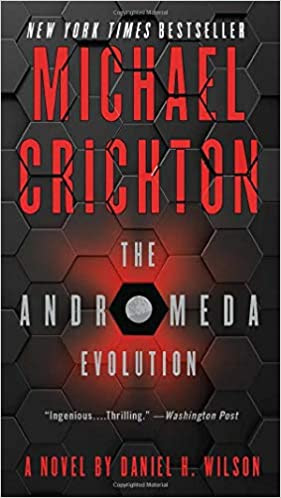
    Finally, I note that Michael Crichton’s name dwarfs Daniel H. Wilson’s on the book’s cover.  That’s a savvy marketing ploy, and justifiable since he conceived the series’ storyline and wrote Book One.  But still, he didn’t have much to do with this one.  This is the second book I’ve read recently where this situation arose (the other one is reviewed here), and I think it’s a mixed blessing to be chosen to continue a famous author’s series after he’s passed away.


    In the end, the key questions are:  1.) Was Daniel H. Wilson successful in copying Michael Crichton’s literary style?  2.) Was The Andromeda Evolution just as thrilling, scientifically speculative, and convincing as Crichton’s original?  3.) Would I recommend this book to readers thirsting for another Michael Crichton book?  The answers are: Yes, Yes, and Yes.


    8 Stars.  Fiction or not, I thought The Andromeda Evolution was a timely read, given that we mired in a seemingly unending pandemic and have to deal with a vocal and confrontational minority who hold that the proper strategy is “ignore it and it will go away.”